
Photo by Ty Carlson on Unsplash
On February 6th 2020, Casper - the online mattress retailer - went public. This was a significant milestone for the company as it represented the culmination of a series of successes from when they initially started and were told repeatedly that it was a bad idea as no one in their right mind would buy a mattress online without trying it first. The founding team of 5 who all still hold positions in the company believed in the idea and through their tenacity grew the company to a valuation at one point of $1.1 billion. However, while this marked a step forward, reception to their IPO has been lackluster and in addition to falling revenues, the current valuation has fallen to $575 million.
Yet Casper CEO, Philip Krim, is adamant that as they look to the future and spend inwards on R&D and market research, Casper is poised to grow beyond a mattress company to “the Nike of sleep”. While analysts think differently, based on the hurdles Casper have had to jump through to get to this point and their resilience, they very well could. So with that, I wanted to examine the development of Casper from its inception to now, outline the different milestones they have achieved, and where they seem poised to go from here.
Inception - Pre-Seed and Seed
Casper was founded in 2014 by 5 friends - Philip Krim, Neil Parikh, Luke Sherwin, Jeff Chapin and Gabe Flateman who saw a gap in the market that was being slept on (no pun intended). The market conditions were favorable with two proponents for their initial success:
The makeup of the market for mattresses
The timing
At the time the mattress industry was the same as it had been for years, with providers advertising through low budget infomercials and the only outlets being mattress stores. Everyone needs to sleep, and everyone needs a mattress and in 2014, the US mattress market was worth $10 billion. The market was safe, unsexy, and retailers didn’t need to push the value hard with marketing and advertising being the biggest source of traffic to their stores. Even then, the experience of buying a mattress was so arduous with stores being out the way, having to plan for a large car to get it back and then once home it was a laborious process getting it inside the home and set up.
Building from the point of view of the customer experience, Casper set out to address all of the above pain points. They conceived of making an affordable foam mattress that consumers could buy online and would ship in a box that could easily fit through a doorway and be set up in minutes.
Secondly, around this time sleep and all its benefits were being talked about more and more with media outlets and public figures touting the power of sleep. With consumers thinking a bit more critically about how they sleep and on what, Casper was ready to make themselves stand out from the competition.
But this idea was met with resistance. Casper COO, Neil Parikh, recalled how the first investors they reached out to said “no one is going to buy a mattress online/this is a dumb idea/don’t do it” and how despite all that, the founders kept going and initially funded the initial launch through an ‘irresponsible’ (in Parikh’s own words) credit card debt of approximately $50,000 - $100,000. There was a lot that could go wrong, however as they pushed forward, if they were right about the market opportunity, then there was a lot that could go right.
Out of this time came the first success in that they landed a seed fund of $1.6 Million from NYC based VC fund Lerer Hippeau, who brought their expertise in direct-to-consumer marketing to Casper. The result, their first stock of their inventory was sold out on the first day the Casper site went live 2 months later in April 2014 and they racked up $1 Million in revenue in their first 28 days.
Through a combination of tenacity, entrepreneurial spirit and leveraging the skills, network and finances offered by a VC firm in their seed round, Casper had successfully begun a disruption of the mattress market that has continued to this day with many competitors such as Leesa Sleep and giants such as Amazon and Target peddling their own offerings. But Casper were the first and they still lead the way in terms of innovation.
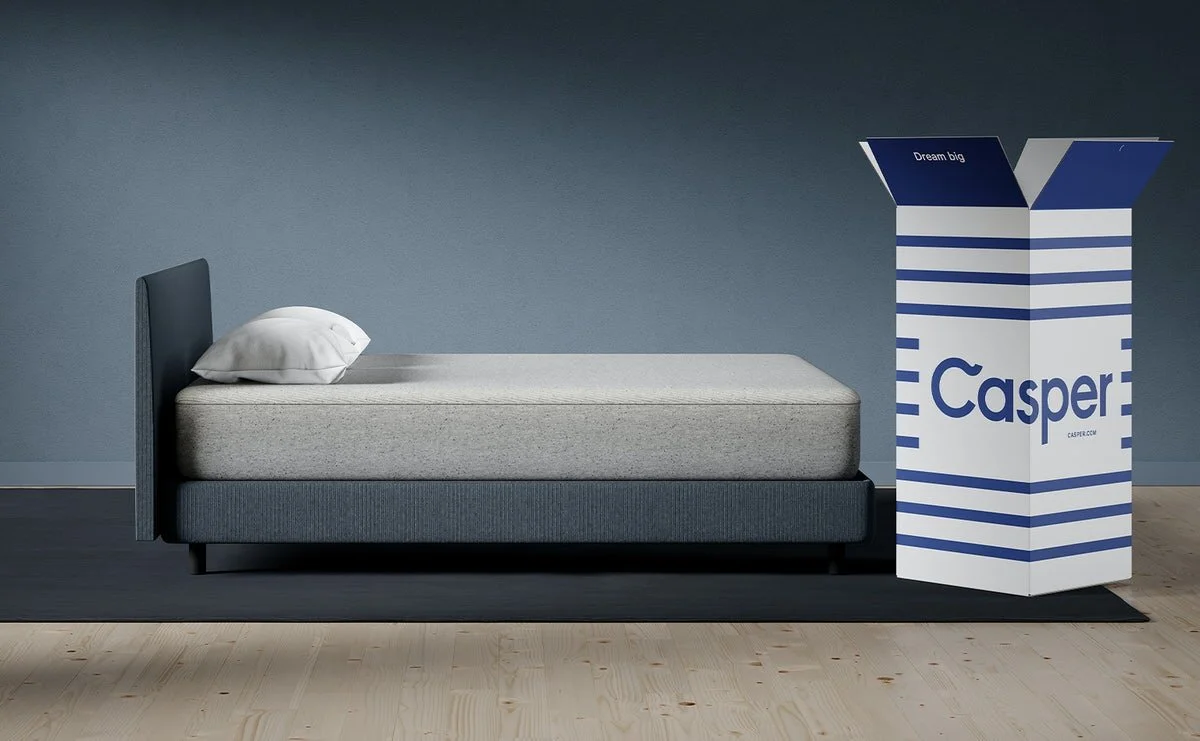
Product Image taken from Casper.com
Series A - Early Successes
With a success story under their belt, and revenues rising, it wasn’t long until investors realised how wrong they were about Casper. Only 6 months after their seed funding, Casper, looking to expand their operations, raised a Series A of $13.1 Million led by New Enterprise Associations but was also backed by celebrity investors such as actor Ashton Kutcher and rapper Nas.
This celebrity endorsement was another indicator of how Casper was achieving success. As people were telling their friends about their new mattress and due to the novelty of receiving a mattress in a box, unboxing videos on YouTube (which are actually really exciting to watch!) started taking off, racking up millions of views. Casper built on this organic marketing, not being able to compete with mattress giants at this stage - by offering discount and reward codes for referrals. Furthermore, they interacted with their customers sending them champagne for Valentines day and sharing fun sleep related articles on their social media page. They built their brand to become a viral sensation, and through that celebrities and public figures were taking notice. Casper had perfectly positioned themselves to market to the millennial audience.
In their first 10 months as a company Casper made $20 Million in sales. Most startups don’t see that until their 3rd or 4th year as a business. Casper learned from this and did something smart which was development into their first product outside of the mattress - the Casper pillow. This was the first in a series of products that is starting to define Casper as a company concerned with all things sleep. With that, in April 2015 they open Casper Sleep Labs, an R&D space for sleep products. Expecting only a few hundred people to sign up, 15,000 did trusting that they would be a part of making great products with a great company.
With a shoestring marketing budgeting (a Twitter account) but a deep connection with their customers, Casper achieved a lot in their first year. And with this, there was only the next step to take.
Series B - Scaling Up
With new products and side businesses under the umbrella of Casper, the team expanded to 70 and to meet the rising demand for Casper in the US, expand internationally, and grow the team they raised $55 Million of Series B funding once again led by Lerer Hippeau and IVP - a late stage VC firm.
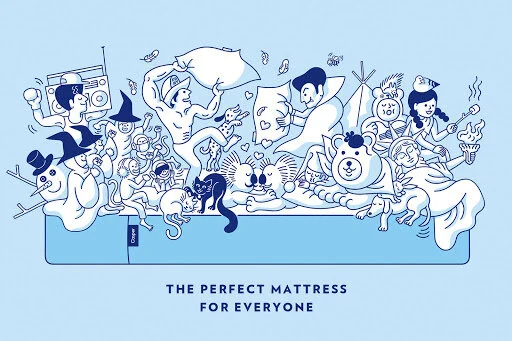
During this time, they did just that but now armed with a strong cash position to compete with larger industry incumbents, Casper poured a lot of effort in marketing. Learning from their successes with their customer base, they leveraged a space they knew their targeted customer base was sure to see their ads - the New York subway. They designed cute, hip subway advertisements that made people think, laugh and because of that they effected an even more successful word-of-mouth marketing campaign. This led to Casper closing the year at 100 employees and $100 million in sales making them among one of the fastest growing consumer brands in the US.
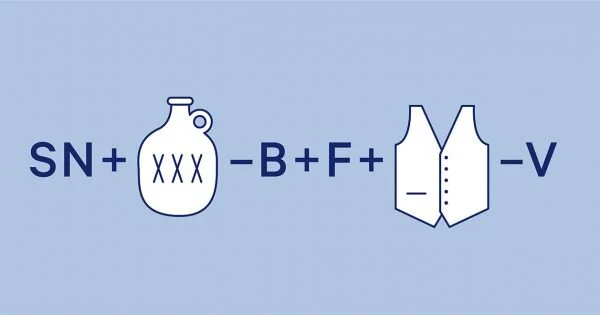
Subway ads for Casper showing brain teasers, and intricate and captivating drawings
Series C - Finding new Customers
Over the next 2 years Casper received accolades for “Best Invention of the Year”, reached 1 billion impressions on social media, launched new products such as sheets and dog beds, and reached $250 Million in sales. While the market for bed-in-a-box was booming, this also meant that competitors were starting to wise up and make their own products with slight variations in their value-offerings. The space was becoming crowded, and the number of consumers willing to buy online was diminishing and Casper needed to set their sights on a broader consumer base. Basically, they needed a brick-and-mortar solution for retail.
Through this need, in June 2017, Casper raised $170 Million in Series C funding led by Target - one of the US leading retail brands. With their support and guidance, Casper began to open retail points and developed more products for sleep and wellness.
With this, revenues continued to rise, with Casper continued beating out rivals even as the market began to grow. They were set to see their biggest days as they set their sights on Unicorn status.
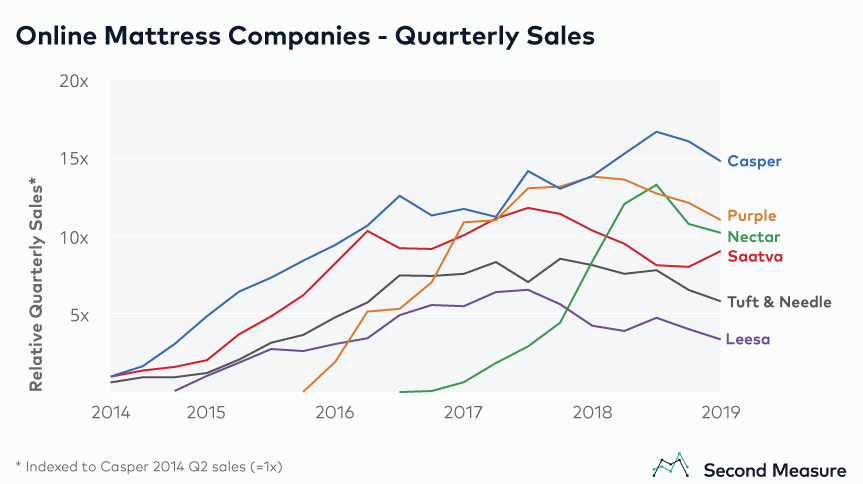
Casper growth compared to main competitors from 2014 to 2019
Series D - Unicorn
By 2019, Casper had expanded to Canada, France, Germany, Austria, Switzerland and the United Kingdom. However, the world is a bigger place and looking to expand even more globally Casper raised their last round of funding at Series D of $100 Million. This was led by existing investors and it was at this point that a Bloomberg report valued them at $1.1. Billion giving Casper “unicorn” status.
In a statement from CEO Krim, the round was there to “accelerate Casper’s vision to become the world’s largest end-to-end sleep company.” and “ (have) growth ... continue to be catalyzed by state-of-the-art sleep products, best-in-class customer experiences, and world-class leadership”.
It was clear that relying on their knowledge of the market and becoming experts in sleep, Casper had done some market analysis and understood that their market had gone beyond the now $14 billion dollar mattress market of which they captured 2%. They set their sights on an even larger market of $432 Billion - the market for sleep in wellness.
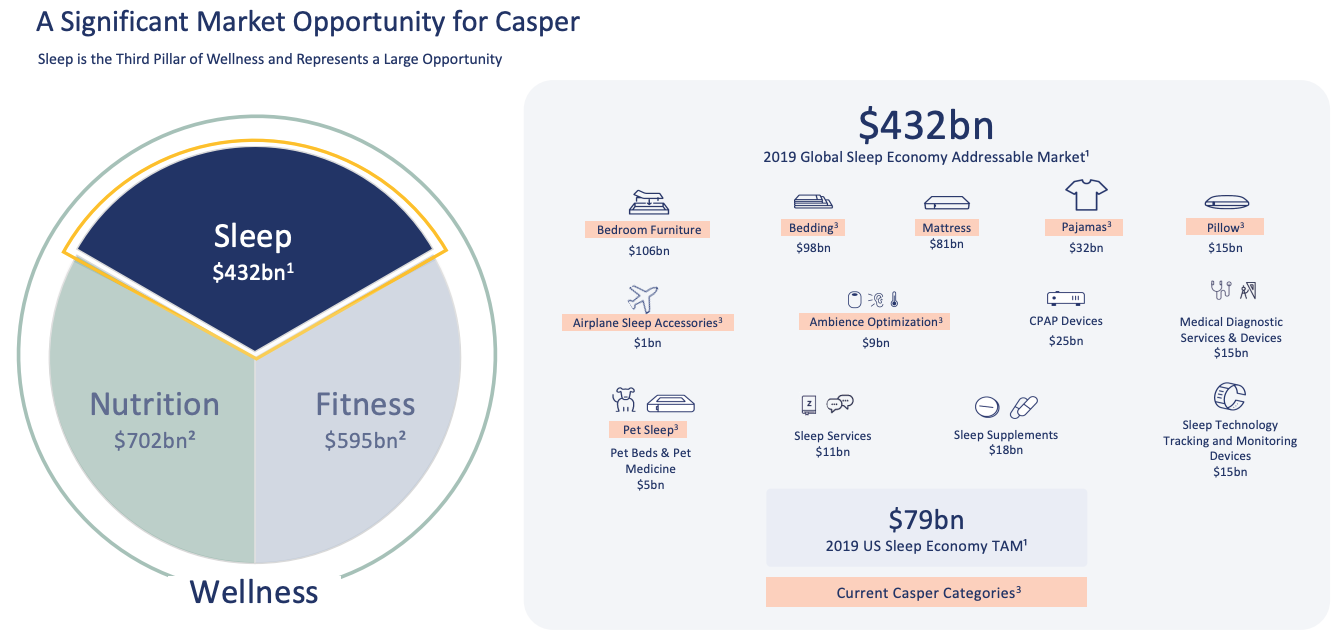
Market opportunities for Casper taken from Casper Investor report with data from studies of the market for sleep commissioned by the company
Currently they are addressing a market of $332 Billion (76% of the addressable market for sleep) and with that brings new and fresh opportunities.
IPO - A Failed Launch?
In February of 2020, Casper went public pricing its IPO at $12 per share. The market opened at $14.50 surging to a high of $15.85 and closing out at $13.50 up 12% on its first day. However based on where shares opened, this dropped their valuation down to $575 Billion leading many to call it a ‘failed’ launch and the company has seen share prices drop steadily since then.
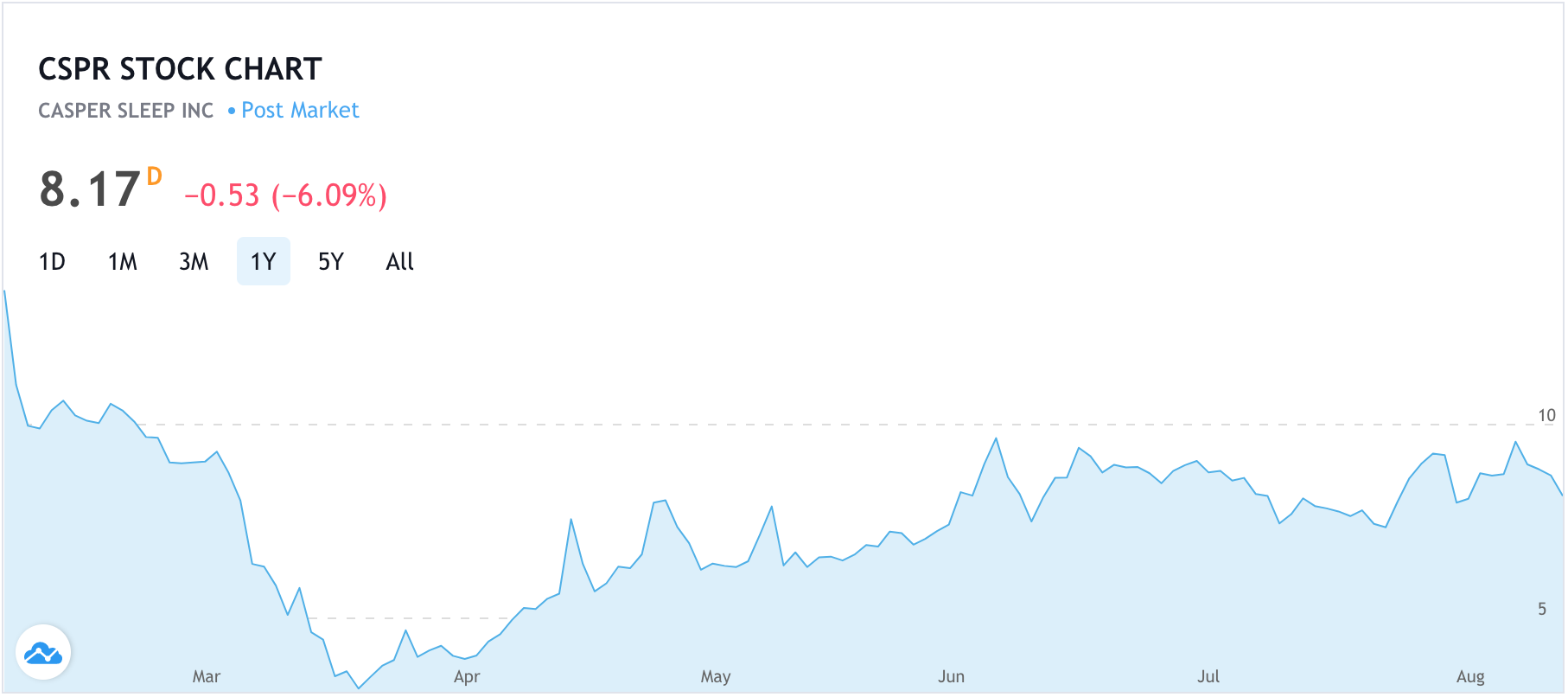
Caspers all time stock chart taken from Crunchbase on August 14, 2020.
Additionally, while the company posted a 20% revenue increase year-over-year, their net losses widened by 5% making investors uncomfortable with this direction. However, the founding team seems unfazed as they continue to broaden their vision which, according to CEO, Krim, is “building the world’s first sleep brand”. COO, Parikh went a step further touting the ambition to be “The Nike of sleep” and seemingly explaining the losses as an investment into R&D.
The Future of Casper
Whether or Casper achieves their lofty goals, only time will tell. However, they have been successful so far in their (short) climb to unicorn status. While it seems that investors looking at Casper from the outside have their doubts (as they’ve had since day 1) there must be a reason why during each round of funding they have raised, the same investors keep jumping on indicating a belief in the tenacity and agility of the team to meet new market opportunities and pivot in the face of competition. For this, the continual growth in new products and services from the company, and the fact that my Casper mattress is indeed the most comfortable mattress I’ve ever slept in, in my eyes, Casper seems to have an even bright future ahead.