How did Casper become a Billion Dollar company? /  by Usamah Khan

Photo by Ty Carlson on Unsplash

Photo by Ty Carlson on Unsplash

On February 6th 2020, Casper - the online mattress retailer - went public. This was a significant milestone for the company as it represented the culmination of a series of successes from when they initially started and were told repeatedly that it was a bad idea as no one in their right mind would buy a mattress online without trying it first. The founding team of 5 who all still hold positions in the company believed in the idea and through their tenacity grew the company to a valuation at one point of $1.1 billion. However, while this marked a step forward, reception to their IPO has been lackluster and in addition to falling revenues, the current valuation has fallen to $575 million.

Yet Casper CEO, Philip Krim, is adamant that as they look to the future and spend inwards on R&D and market research, Casper is poised to grow beyond a mattress company to “the Nike of sleep”. While analysts think differently, based on the hurdles Casper have had to jump through to get to this point and their resilience, they very well could. So with that, I wanted to examine the development of Casper from its inception to now, outline the different milestones they have achieved, and where they seem poised to go from here.

Inception - Pre-Seed and Seed

Casper was founded in 2014 by 5 friends - Philip Krim, Neil Parikh, Luke Sherwin, Jeff Chapin and Gabe Flateman who saw a gap in the market that was being slept on (no pun intended). The market conditions were favorable with two proponents for their initial success:

  1. The makeup of the market for mattresses

  2. The timing 

At the time the mattress industry was the same as it had been for years, with providers advertising through low budget infomercials and the only outlets being mattress stores. Everyone needs to sleep, and everyone needs a mattress and in 2014, the US mattress market was worth $10 billion. The market was safe, unsexy, and retailers didn’t need to push the value hard with marketing and advertising being the biggest source of traffic to their stores. Even then, the experience of buying a mattress was so arduous with stores being out the way, having to plan for a large car to get it back and then once home it was a laborious process getting it inside the home and set up. 

Building from the point of view of the customer experience, Casper set out to address all of the above pain points. They conceived of making an affordable foam mattress that consumers could buy online and would ship in a box that could easily fit through a doorway and be set up in minutes.

Secondly, around this time sleep and all its benefits were being talked about more and more with media outlets and public figures touting the power of sleep. With consumers thinking a bit more critically about how they sleep and on what, Casper was ready to make themselves stand out from the competition.

But this idea was met with resistance. Casper COO, Neil Parikh, recalled how the first investors they reached out to said “no one is going to buy a mattress online/this is a dumb idea/don’t do it” and how despite all that, the founders kept going and initially funded the initial launch through an ‘irresponsible’ (in Parikh’s own words) credit card debt of approximately $50,000 - $100,000. There was a lot that could go wrong, however as they pushed forward, if they were right about the market opportunity, then there was a lot that could go right.

Out of this time came the first success in that they landed a seed fund of $1.6 Million from NYC based VC fund Lerer Hippeau, who brought their expertise in direct-to-consumer marketing to Casper. The result, their first stock of their inventory was sold out on the first day the Casper site went live 2 months later in April 2014 and they racked up $1 Million in revenue in their first 28 days. 

Through a combination of tenacity, entrepreneurial spirit and leveraging the skills, network and finances offered by a VC firm in their seed round, Casper had successfully begun a disruption of the mattress market that has continued to this day with many competitors such as Leesa Sleep  and giants such as Amazon and Target peddling their own offerings. But Casper were the first and they still lead the way in terms of innovation.

Product Image taken from Casper.com

Product Image taken from Casper.com

Series A - Early Successes

With a success story under their belt, and revenues rising, it wasn’t long until investors realised how wrong they were about Casper. Only 6 months after their seed funding, Casper, looking to expand their operations, raised a Series A of $13.1 Million led by New Enterprise Associations but was also backed by celebrity investors such as actor Ashton Kutcher and rapper Nas.

This celebrity endorsement was another indicator of how Casper was achieving success. As people were telling their friends about their new mattress and due to the novelty of receiving a mattress in a box, unboxing videos on YouTube (which are actually really exciting to watch!) started taking off, racking up millions of views. Casper built on this organic marketing, not being able to compete with mattress giants at this stage - by offering discount and reward codes for referrals. Furthermore, they interacted with their customers sending them champagne for Valentines day and sharing fun sleep related articles on their social media page. They built their brand to become a viral sensation, and through that celebrities and public figures were taking notice. Casper had perfectly positioned themselves to market to the millennial audience. 

In their first 10 months as a company Casper made $20 Million in sales. Most startups don’t see that until their 3rd or 4th year as a business. Casper learned from this and did something smart which was development into their first product outside of the mattress - the Casper pillow. This was the first in a series of products that is starting to define Casper as a company concerned with all things sleep. With that, in April 2015 they open Casper Sleep Labs, an R&D space for sleep products. Expecting only a few hundred people to sign up, 15,000 did trusting that they would be a part of making great products with a great company.

With a shoestring marketing budgeting (a Twitter account) but a deep connection with their customers, Casper achieved a lot in their first year. And with this, there was only the next step to take.

Series B - Scaling Up

With new products and side businesses under the umbrella of Casper, the team expanded to 70 and to meet the rising demand for Casper in the US, expand internationally, and grow the team they raised $55 Million of Series B funding once again led by Lerer Hippeau and IVP - a late stage VC firm. 

During this time, they did just that but now armed with a strong cash position to compete with larger industry incumbents, Casper poured a lot of effort in marketing. Learning from their successes with their customer base, they leveraged a space they knew their targeted customer base was sure to see their ads - the New York subway. They designed cute, hip subway advertisements that made people think, laugh and because of that they effected an even more successful word-of-mouth marketing campaign. This led to Casper closing the year at 100 employees and $100 million in sales making them among one of the fastest growing consumer brands in the US.

Subway ads for Casper showing brain teasers, and intricate and captivating drawings

Subway ads for Casper showing brain teasers, and intricate and captivating drawings

Casper 2.jpg

Series C - Finding new Customers

Over the next 2 years Casper received accolades for “Best Invention of the Year”, reached 1 billion impressions on social media, launched new products such as sheets and dog beds, and reached $250 Million in sales. While the market for bed-in-a-box was booming, this also meant that competitors were starting to wise up and make their own products with slight variations in their value-offerings. The space was becoming crowded, and the number of consumers willing to buy online was diminishing and Casper needed to set their sights on a broader consumer base. Basically, they needed a brick-and-mortar solution for retail. 

Through this need, in June 2017, Casper raised $170 Million in Series C funding led by Target - one of the US leading retail brands. With their support and guidance, Casper began to open retail points and developed more products for sleep and wellness.

With this, revenues continued to rise, with Casper continued beating out rivals even as the market began to grow. They were set to see their biggest days as they set their sights on Unicorn status.
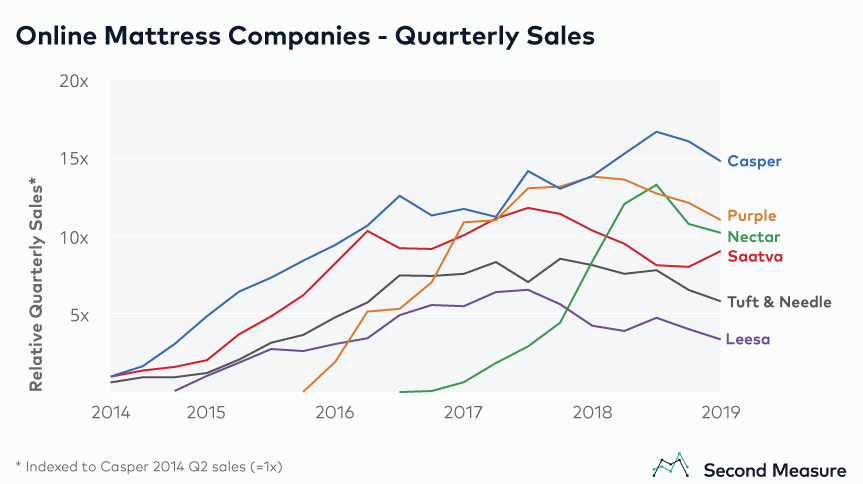
Casper growth compared to main competitors from 2014 to 2019

Casper growth compared to main competitors from 2014 to 2019

Series D - Unicorn

By 2019, Casper had expanded to Canada, France, Germany, Austria, Switzerland and the United Kingdom. However, the world is a bigger place and looking to expand even more globally Casper raised their last round of funding at Series D of $100 Million. This was led by existing investors and it was at this point that a Bloomberg report valued them at $1.1. Billion giving Casper “unicorn” status.

In a statement from CEO Krim, the round was there to “accelerate Casper’s vision to become the world’s largest end-to-end sleep company.” and “ (have) growth ... continue to be catalyzed by state-of-the-art sleep products, best-in-class customer experiences, and world-class leadership”.  

It was clear that relying on their knowledge of the market and becoming experts in sleep, Casper had done some market analysis and understood that their market had gone beyond the now $14 billion dollar mattress market of which they captured 2%. They set their sights on an even larger market of $432 Billion - the market for sleep in wellness.
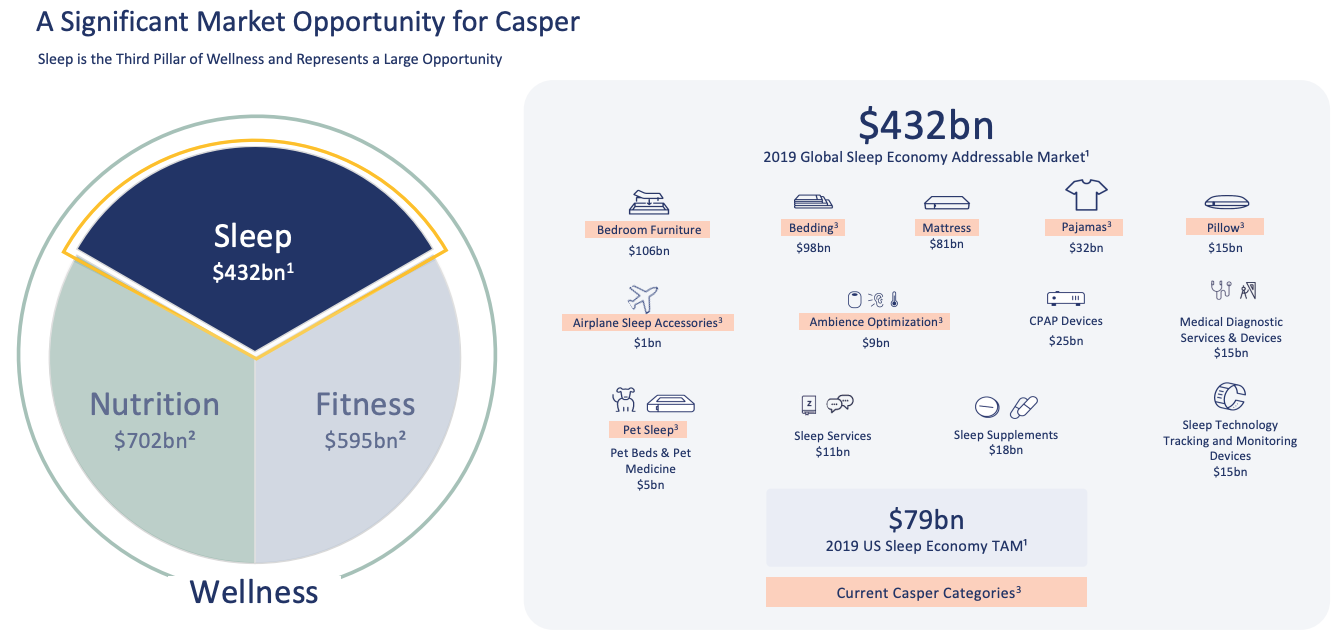
Market opportunities for Casper taken from Casper Investor report with data from studies of the market for sleep commissioned by the company

Market opportunities for Casper taken from Casper Investor report with data from studies of the market for sleep commissioned by the company

Currently they are addressing a market of $332 Billion (76% of the addressable market for sleep) and with that brings new and fresh opportunities.

IPO - A Failed Launch?

In February of 2020, Casper went public pricing its IPO at $12 per share. The market opened at $14.50 surging to a high of $15.85 and closing out at $13.50 up 12% on its first day. However based on where shares opened, this dropped their valuation down to $575 Billion leading many to call it a ‘failed’ launch and the company has seen share prices drop steadily since then. 
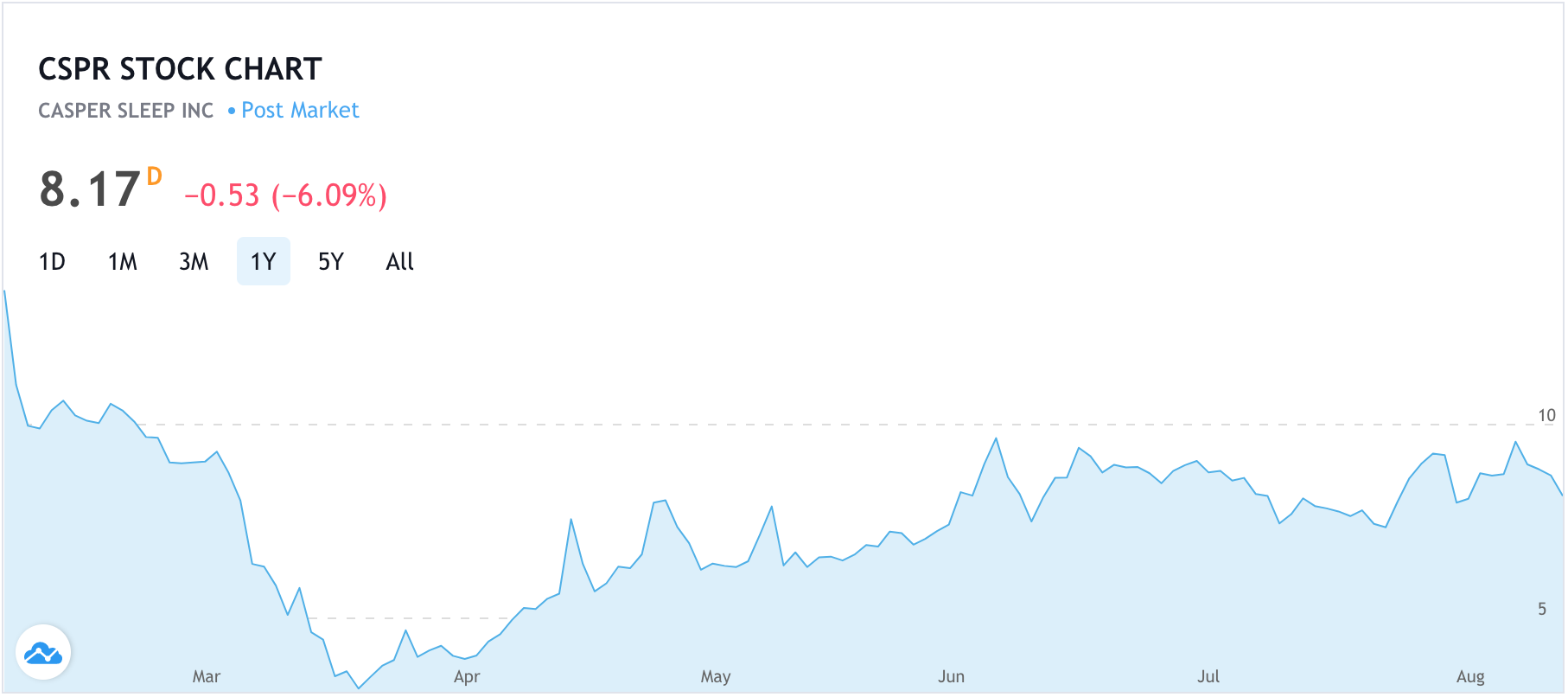
Caspers all time stock chart taken from Crunchbase on August 14, 2020.

Caspers all time stock chart taken from Crunchbase on August 14, 2020.

Additionally, while the company posted a 20% revenue increase year-over-year, their net losses widened by 5% making investors uncomfortable with this direction. However, the founding team seems unfazed as they continue to broaden their vision which, according to CEO, Krim, is “building the world’s first sleep brand”. COO, Parikh went a step further touting the ambition to be “The Nike of sleep” and seemingly explaining the losses as an investment into R&D.

The Future of Casper

Whether or Casper achieves their lofty goals, only time will tell. However, they have been successful so far in their (short) climb to unicorn status. While it seems that investors looking at Casper from the outside have their doubts (as they’ve had since day 1) there must be a reason why during each round of funding they have raised, the same investors keep jumping on indicating a belief in the tenacity and agility of the team to meet new market opportunities and pivot in the face of competition. For this, the continual growth in new products and services from the company, and the fact that my Casper mattress is indeed the most comfortable mattress I’ve ever slept in, in my eyes, Casper seems to have an even bright future ahead.

Opportunities for IoT and a Connected Future /  by Usamah Khan

Photo by BENCE BOROS on Unsplash

Photo by BENCE BOROS on Unsplash


When I think about the future, I get most excited about the potential of the Internet of Things (IoT). It represents a step forward for connectivity and brings with it a whole host of new and exciting possibilities. With billions of devices around the world connected and sharing data, from fridges to air quality sensors, the world around us is becoming smarter, responding to our needs in intelligent and deliberate ways. Working in the IoT space for over 3 years now, I’ve developed a pretty good feel for how to access and make sense of open-source IoT data, and what kind of products can be built harnessing the data. However, recently I’ve been curious and drawn towards what opportunities are out there and overarching strategies companies need to take to jump on the IoT revolution. With 5G just around the corner, enabling faster connectivity and possibilities for IoT, I think no matter what the industry, it will be more and more crucial to have an understanding of the underlying technologies and the opportunities associated with it.

So with that, I collected my thoughts and wrote this with the aim to understand and explain the market opportunities within IoT and the end value it can bring to firms. Furthermore, I’ve pieced together my own ideas on what I think are some strategies to take if you’re thinking of starting an IoT company or for organizations looking towards a connected future.


A CONNECTED FUTURE


IoT has cemented its place in the world but 5G is the next frontier. Boasting faster speeds and lower latency, 5G stands to change the landscape for consumers but more importantly, industries such as healthcare, manufacturing, insurance and banking. With IoT devices connected on 5G networks, data can move from distant servers to ‘edge devices’ and sensors will be able to process and share data faster leading to more up to date business decision making. However, this advancement will also introduce uncertainty along many dimensions. Companies and ideas that develop and invest in a future strategy aligning these disruptive technologies and mitigating the uncertainty will see this as their key competitive advantage.

In shaping what a vision for the future looks like, it’ll be imperative that your strategy advances connection between people, builds on your competitive strengths and embraces new opportunities for an integrated digital future. With the plethora of opportunities available there’s room at this early stage to cement yourself as an industry ‘go-to’ when it comes to developing and offering IoT infrastructures and frameworks.

If you’re doing anything to advance an IoT agenda, understand what makes a successful IoT strategy and build on that or help others achieve that. Based on a 2018 study of 300 IoT executives and what I’ve learned over the last few years, a winning 5G/IoT strategy should comprise the following aspects:

  1. Understanding the need for Device-enablement platforms

  2. Building on a firm’s strengths when implementing IoT

  3. Deploying multiple use cases internally and externally to climb the IoT learning curve

  4. Embracing opportunities for business-process changes

  5. Co-creating with startups that fill a gap in value

  6. Paying attention to market opportunities and where IoT is needed the most

  7. Leveraging Blockchain for secure and transparent data


Device-Enablement Platforms


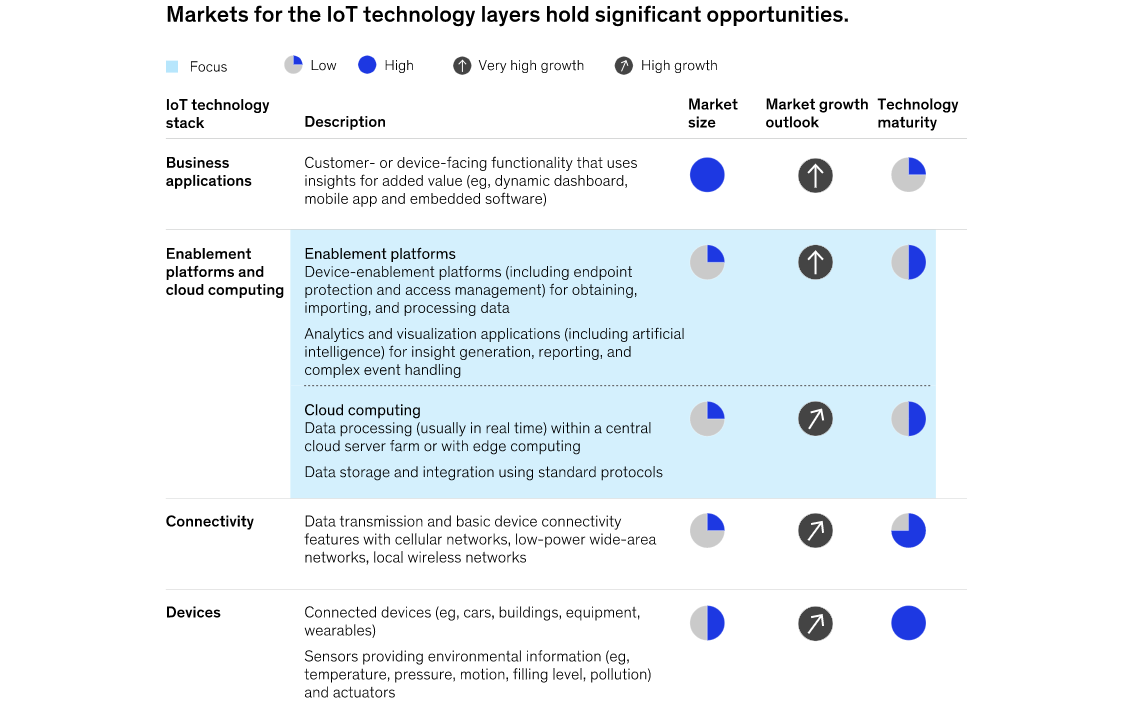
In 2019, a McKinsey review of the growing opportunities in IoT indicated the importance and growth of ‘device-enablement’ platforms. Device-enablement platforms collect and link data from disparate IoT devices and process them through cloud services allowing us to generate insights from large amounts of data.

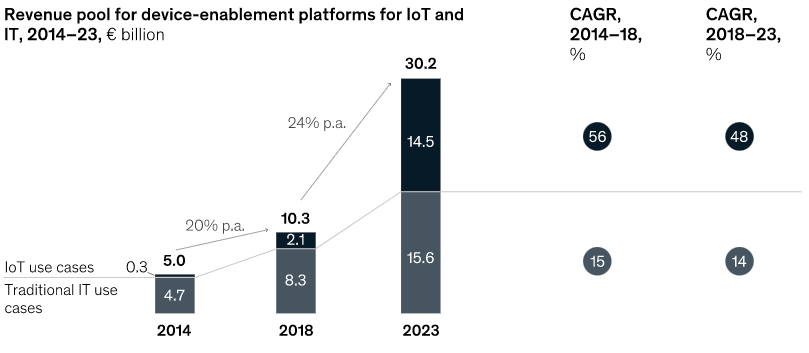
The simplest way to describe the opportunities in the market for device enablement platforms is by focusing on lowering the barriers to implementation for SMEs who have few resources to develop IoT solutions on their own. Doing so has the potential to attract new clients and the uptake of businesses requiring these services will result in a revenue pool estimated to grow at an average CAGR 24% (48% for IoT specific use cases) between 2018 - 2023.

 
Figure 1: Revenue pool for device-enabled platforms, 2014-2023 (Dahlqvist et al., 2019)

Figure 1: Revenue pool for device-enabled platforms, 2014-2023 (Dahlqvist et al., 2019)


While this can be used as an indicator of the potential payout of investing in and developing a 5G/IoT strategy, doing so will require a realignment of shared values. A successful strategy for a startup or a company will take a multi-tiered approach taking into account the needs of businesses in a 5G / IoT powered world and deliver value accordingly.


Build on Strengths


Companies that garner the most economic benefit from IoT are those who played to their strengths and add connectivity to their existing products. Those developing new products and services for their customers from the ground-up find themselves in the bottom quintile of economic return.

The first strategy should be to lower the barriers to implementation for IoT. This can be achieved in two ways.

Firstly, develop frameworks for easy deployment and integrations of solutions. This value enables new businesses to be free to not pump costs into R&D but focus on what they do best and what gives them their competitive advantage.

Secondly, to help achieve this, add consulting to your suite of services through learning from your experiences and being able to react to needs and offer tailored solutions. By building highly skilled developers and consultants in your team, SMEs as well as larger firms can turn to you with their strategies and your consultants can stand to learn more about the landscape and effectively draw in new clients to a growing ecosystem. Co-evolution and collaboration are vital in industries where network externalities are crucial to corporate success and the more customers see peers join a network, the stronger the network effect gets.

Growing the ecosystem and learning from new firms will lead to a competitive advantage for you in your relevant industries. Additionally, vertically integrating the stack from Developers to business decision-makers allows you to create value in ways rivals cannot.


Deploy Multiple use cases


One or two deployments of IoT services statistically does not make a transformative impact on firms. In fact, it’s been studied that the greater the number of IoT use cases, the greater the correlation with financial success. This number is approximately 30 IoT projects deployed after which the effect starts to level off. It is the momentum in propelling these initiatives that leads to the widespread adoption and efficiency of IoT projects.

You can stand to learn from this and pour as much brainpower as you can into R&D projects for 5G and IoT powered devices. One of the biggest trends in organizational behaviour in the digital age is an appetite for risk creating a bias towards action. Top talent wants to work on these innovative projects and building a culture enabling this has side benefits to just a happier workforce.

Efficiencies manifest themselves as engineers are able to develop and use similar frameworks and solutions across projects. Learning from a variety of projects can also deepen domain knowledge, increasing the value that you can offer to customers and increasing the potential number of new customers you can attract. For all you know, you might find a niche as your team gravitates towards solving a certain set of problems.


Embrace Business-Process Changes


IoT is not a be-all, end-all solution to the current business problems being faced by firms. However, if employed correctly, IoT devices can improve decision making by generating previously unobtainable data. However, while the data can be generated easily, without insights the data is of no use to frontline employees needing to leverage the data for better decision making.

As such, along with building products that improve connectivity, look to extend a suite of services to cloud-based analytics and consulting services that can package the newly generated data into useful insights relevant to managers and other decision-makers. Managing these changes will be crucial for success and if you lend both a hand and an extra set of eyes to your customers, you make yourself invaluable.

But always keep the user in mind! IoT will flourish and will change the way many businesses operate. But if we can democratize it at this early stage and break down barriers in understanding the relevancy, we can increase adoption and bring in outside perspectives to unlock a whole new realm of possibilities.


Pay Attention to Market Opportunities


Building on the idea of learning while doing and identifying new possibilities, those looking to get into the device-enablement space have their pick of applications. Right now we’re in a stage where the most opportunities lie in improving business applications and the technology is relatively immature. This makes it an area that especially business users can maybe put their heads together to build.


Understanding data has never been more important. With platforms like thingful allowing you access to millions of sensors around the world, building ways to understand, package and relay that data to help others to do what they do best will make you so incredibly valuable.

But don’t forget about device-enablement. The market is small right now but projected to grow exponentially for the future. Those who get on board now, learn as much as they can and help other companies do better stand to cement themselves as future leaders.


work with Startups


Why pour money into something that’s already being done? Employ a mindset of “work with those who know and do it better”. If you’re a large firm and have the resources to invest heavily in developing new solutions internally, make use of the fact that business centers around the world are hotspots for tech startups and innovation. Look around to your community and focus energy in combining heads and working with startups involved in IoT but also related technologies such as cloud computing, big data analytics, cloud gaming, edge computing and cyber-security. Being able to quickly learn, collaborate and co-create will advance the work we can do in IoT and most importantly uplift you and those who you work with.

The right partnerships can stand to bring large returns and with IoT Collaboratives popping up around the world in research institutions, I’d love to see this be embraced more and more. Because as we’ve seen in the case of incubators and accelerators, those who work together learn and do better.


Understand Blockchain


Lastly, you need to understand Blockchain If you plan to do anything with the data from IoT sensors, it’s crucial that it be accurate, traceable and transparent. It would benefit you or your team to get a handle on the technology as you build out your solutions. While there are many resources available to get to grips with Blockchain in IoT, briefly Blockchain allows for authentication, security and transparency along the major points in the IoT device lifecycle:

  • Blockchain allows for authentication in registering a device enabling trust in the data generated from day 1

  • Through distributed ledgers, transactions and readings are transparent and can be traced along different axes

  • Transmission of data between devices can be authenticated and securely processed

  • Through the distributed ledger, Blockchain can allow fast transfer and coordination of many billions of sensors

  • As the ledger is virtually un-hackable, you can be certain of the accuracy and traceability of the data


Where to go from here?


No doubt 5G and IoT are set to disrupt the landscape of business interaction. However, the way in which you respond to this disruption will determine your possibility for future success. Find ways of providing value through education, consulting and increasing the ease of implementation. If you’re lucky enough to have the resources to offer high-end solutions, still be cognizant of the ability of young, lean, niche and agile startups who are offering value in innovative ways to consumers. Finally, pay attention to the tech that binds this all together. AI, blockchain, edge-computing - all these are just tools to help people connect or make sense of data better. So use them, and make your idea a reality.

These are just some of my ideas, but leave a comment, get in touch or drop me a line if you want to chat more! I always have time to discuss the exciting opportunities of the future.

 
Photo by Swapnil Bapat on Unsplash

Creativity and learning from Cross-disciplinary Interaction /  by Usamah Khan

Photo by Kai Pilger on Unsplash

Photo by Kai Pilger on Unsplash

One of my favourite videos is Victor Wooten’s “The Language of Music and How to Speak It”. I used to watch it a lot when I was younger in my pursuit of becoming a better musician. While I highly recommend watching the whole video to get insight into creativity and inspiration, one line always stuck with me:

“if I want to be a better bassist, I need to listen to other bassists. If I want to be a better musician, I need to listen to all musicians”.

Victor Wooten is known for his signature tapping style - playing his bass like a piano. Something he learned from imagining how pianists would play the bass. At the crux of it, his point he was trying to make was that if you play the bass the way it’s ‘supposed’ to be played, you can make beautiful music. But if you gave the bass to a pianist or a golfer who had no idea how to play and just observed what they did and tried to recreate that, you’d be able to approach the instrument in a new more creative light.

I learnt a lot from this video but something I didn’t realize was how much I’d think back to it when trying to get better at other things in my life.

Due to being intensely curious by nature and my need to always learn new, and often random, skills in my life (that summer I learned the harmonica, the winter I took up knitting and my brief stint with calligraphy are examples of where my mind takes me) one thing that’s always stayed with me is how learning something new get’s easier the more you do it, and the more you draw from the lessons you learnt elsewhere, the more creative you become in your other skills.

Let’s look at this again with music. Often, like I mentioned, techniques are borrowed across musicians who employ methods that sound “normal” on one instrument, but “creative” on another. An example is legato, a technique where notes are smoothly connected from one to another, most often found among horn instrumentalists. This sounds commonplace on a horn, however, when employed on a guitar sounds different and creative. Alan Holdsworth who famously used this method on guitar as a way to mimic the horn is by many considered to be one of the most influential and creative guitarists of our time.

Similarly, Vangelis, the composer for “Blade Runner” and one of my favourite soundtracks of all time loved the vibrato sound, a sound really only attainable on string instruments, and built a mod for his synthesizer which influenced much of electronic music as we know it today.

I find this cross-disciplinary learning to be so powerful, especially now when I think about it in the context of a business environment.

In business, creativity manifests itself as something a little different than in music, but the idea is largely, are you thinking differently and able to use that thinking to build and maintain a personal and corporate competitive advantage. Creative individuals in the workforce, not to mention in society, are often highly valued and revered for an ability to look beyond the boundaries imposed on them. The most creative of these individuals often cement themselves as disruptors through their ability to develop innovative out of left field solutions to the known and unknown problems of society. Furthermore, while individual creativity is most often celebrated, collective creativity is just as important. More often than not, it is groups of creative individuals from different fields that produce impactful and creative work. Some argue that, it’s at the intersection of disciplines where most innovation takes place (Parjanen, 2012). That’s why I think it’s so important that leaders of any team understand the role that cross-disciplinary learning plays in creativity and hence should learn how to employ the best strategies to foster collaboration.

The concept of cross domain interaction is known as “Boundary Spanning” (Daley & Jeris, 2004). Boundary spanning has contributed to innovations in all fields, with the Center for Creative Leadership stating in 2014 that “today’s business landscapes requires leaders to bridge boundaries to tap the innovative outcomes that lie at the intersection of groups working together”. Notable examples in business are Elon Musk having said reading a diverse array of books from science-fiction to biographies helped shape what Tesla and SpaceX look like today (Economy, 2018). Another notably disruptive and creative field at the intersection of disciplines is biomimicry - learning from nature to develop better solutions for humans.

But how can leaders get individuals with different backgrounds to work together and subsequently work to achieve a creative goal? This is a two part problem, but one that with a little research we can try to answer.

How to get people across disciplines to collaborate?

Firstly, putting people from different backgrounds in a room can often hinder collaboration if the chemistry between individuals is not there. Participants in this freeform setting are more likely, in an effort to connect with each other (as we as humans want to do), find a common ground therefore limiting themselves to their small area of overlap where neither party is able to draw from their well of experience to explore a solution deeper (Ingram & Morris, 2007). Hence you need to understand the interplay between disciplines and how to manage it.

There a number of studies made to test methods and frameworks for cross-disciplinary collaboration. Joyce et al. suggest the “speedstorming” method (2010). This is an idea akin to that of “speed-dating” whereby placing participants in settings where interaction is limited to one-on-one and time is restricted can help teams understand who they gel with and hence who they can comfortably work with. This method is probably best suited to organizations with a large amount of talent to pull from and where this method would make it possible for the most amount of interactions to take place between employees.

Also, organizing people from different backgrounds requires leaders who have an understanding of the varied strengths and diversity in their team. Ernst and Chrobot-Mason, in their 2011 book, found that managers are rarely equipped with the tools to lead people of different backgrounds. They suggest managers need to first understand the key divisions in organizations - Demographic, Stakeholder, Geographic, Vertical and Horizontal. With this in mind, they can now develop three broad strategies for 1) managing boundaries, 2) forging common ground between team-members and 3) discovering new frontiers together. This can be achieved by leaders buffering the gap between individuals, reflecting on the differences, connecting individuals through collaboration, mobilizing them through creating common purpose and finally weaving the associated strengths of all parties in a web of interdependence to drive the team forward towards creative solutions.

How to achieve a creative goal?

Secondly, while creativity is a phenomenon that has a place in all disciplines, there are considerable differences in how disciplines approach and measure creativity. This is the basis of a study from Atilla Sik in 2015. Sik stated that in order to effectively manage creativity, the first step is to normalize a definition that is applicable to multiple disciplines. Sik references the “social view” or “perspective emphasis”  that states that creativity stems from three elements in a system (Csikszentmihalyi, 1997, 1999):

  1. A culture that contains symbolic rules

  2. A person who brings novelty into the symbolic domain

  3. A field of experts who recognize and validate the innovation.

Secondly, Sik brings out another tool which is acknowledging that creativity is a process. Depending on the school of thought, creative individuals generally follow the same path which are (in a business setting).

  1. Developing an interest

  2. Preparation and planning

  3. Incubation of the idea and ‘mulling it over’

  4. Finding the ‘eureka’ moment

  5. Evaluating the different solutions

  6. Implementing the final solution

If this ironically un-creative, yet important list is understand, it’s possible to begin to take an almost data-driven approach to quantifying creativity and motivation. From this we can hence understand when and where interventions are needed to further this creativity. Furthermore, understanding that following this flow, and placing it within the context of the system in question (the list above) teams can start to build a formula for creativity.

What should we start with?

I would be remiss if I wrote this but didn’t offer my view on where to start. In my opinion, when building a team it comes down to bringing on not just the best people for the job, but those who also have deep or niche interests. Ask your candidates what they do in their own time when no one is telling them what to do. Then ask them to expand, and let them “nerd-out” with you, if only for just a bit. Because chances are, they’re passionate about something. And if you can relate that to what you’re doing, and they can find something to latch on to in your team’s goals, they will take from their experiences and go down the rabbit hole with you and learn how they learn best. And maybe, you might just learn a thing or two to uplift your own-self.

Lastly, if you can understand this for yourself, then try to always find the connection between what you love doing and what you’re working on. I grew up skateboarding, and a lot of the lessons like slamming and getting back up again sit with me at my core. But as a developer, there was something else I was doing when writing code that I didn’t realize until I watched this video from Rodney Mullen, the godfather of skateboarding. He brought together hackers and skaters in the same room, and told them how, essentially, they work the same way. Sometimes when you’re trying to learn a new trick/coding a function, you overshoot, with ‘errors’. Other times, you undershoot. But what both skaters and developers do is understand that now, we’ve found our brackets. It’s now just a matter of closing them in tighter and tighter until it all works out and you roll away/run with no errors.

So learn from what you love, let that influence what you do, and surround yourself with others who like things different to you. Hopefully, you’ll be a better, more creative person for it.

References

Follow this link to references for this post

The Sharing Economy /  by Usamah Khan

Photo by Austin Distel on Unsplash

Over the last few years we’ve seen a change in how we interact with different goods and services. Namely, we’re moving away from ownership towards a culture of ‘borrowing’ someone’s time, space or assets for specific needs. This new marketplace is commonly referred to as “The sharing economy” and, academically speaking, is a place for individuals with ownership of assets to share and rent out their excess supply to others in need. It’s currently a thriving marketplace with key players such as WeWork, Airbnb and Uber, valued at billions of dollars. However, as we enter the next stage of the lifecycle of the sharing economy where we can see big players being challenged by new entries, it seems time to re-examine traditional frameworks and be more inquisitive as to the future.

If I were to wager a guess, over the next three years players in this space should look towards adapting tech such as blockchain and AI, to further facilitate the temporary transfer of ownership as well as work closely with governing entities in drafting policies and regulations for the future. But that’s easy to just say, so this is a study of the what, why and how the future looks from my eyes.

Introducing the Sharing Economy

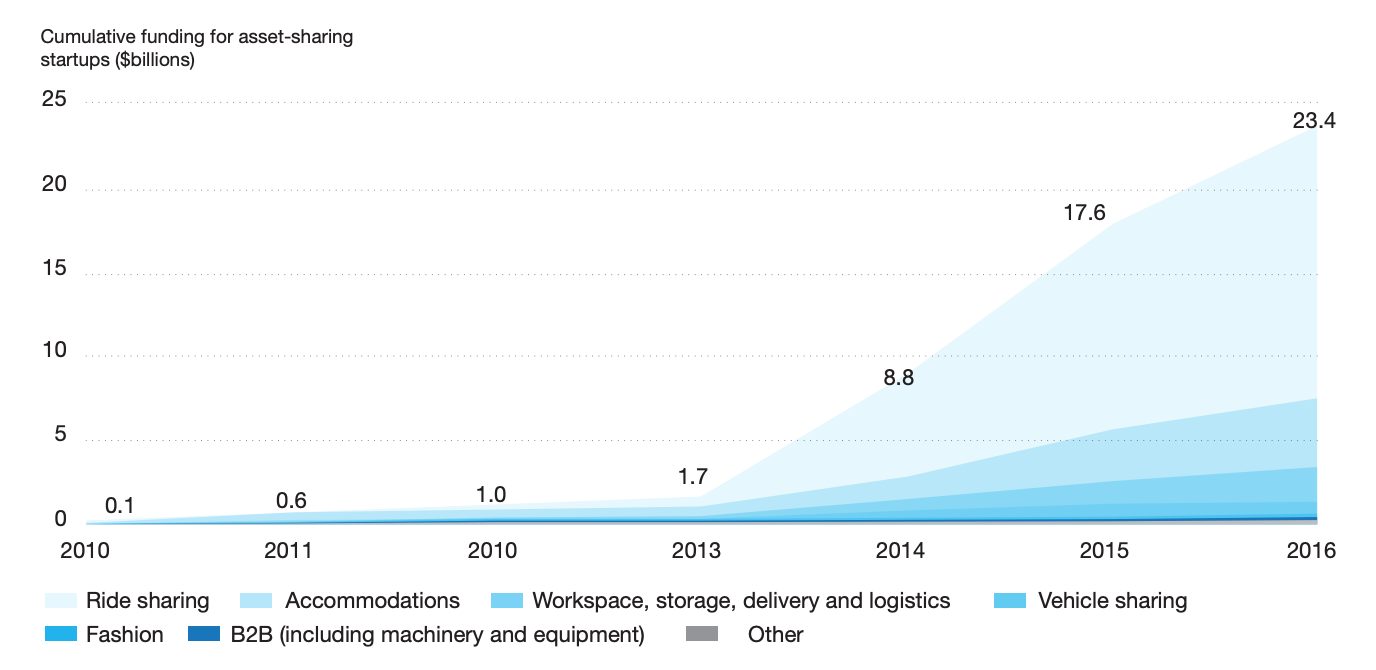
Sharing is one of the oldest concepts in civilization. For years, we’ve bartered, pooled resources, exchanged goods and lent time for services. However, it’s always occurred on a needs basis between individuals and has rarely been facilitated by platforms or groups. With the advent of digital technologies and connectedness, the concept of sharing has not changed, yet the methods by which people can connect with others to rent out their excess supply has drastically improved. This has given rise to this new marketplace for consumers and producers. Ever year more money is being put into “asset-sharing” startups, indicating a growth that seems unlikely to slow down.

Cumulative funding of Asset-Sharing Startups since 2010 (Wallenstein & Shellat, 2017)

Cumulative funding of Asset-Sharing Startups since 2010 (Wallenstein & Shellat, 2017)

The rise of the sharing economy presents a wealth of possibilities, but it is also not without its problems. The aim of this post is to act as a guide to the future by providing, from a marketers perspective, an overview of the sharing economy, its effects on the actors and processes in traditional marketing, and finally what can marketing scholars and practitioners look towards in the future.

What is the sharing economy?

Because of the complexity of the players and driving forces involved, there are many definitions for the sharing economy, and none universally agreed upon. We loosely defined it earlier, but diving a little deeper, at its heart, the sharing economy enables individuals to offer the excess capacity of their assets to others who have a need or desire for it and capitalize on it. Eckhardt et al. (2019) provide an expanded definition that touches on crucial aspects that can be explored to further our understanding. They state that the sharing economy is:

“…a scalable socioeconomic system that employs technology-enabled platforms to provide users with temporary access to tangible and intangible resources that may be crowdsourced”.

There are three key themes to familiarize yourself with as you explore the sharing economy further.

Scalable Socioeconomic System

An economy encapsulates the management and allocation of scarce resources in a community. In a sharing economy, this community is defined by the providers and consumers of an offering. As more people start to recognize the excess supply in their assets and are given the opportunity for a quid-pro-quo economic exchange by sharing, that community grows. In fact, the role of the consumer is also expanded whereby they take on both the demand and supply side of interactions.

Consider Airbnb. A host may offer their extra room one day but then take a holiday in another home the next week. This gives rise to their enhanced role where the producer and consumer become one. A role that we can refer to as the “prosumer”.

Technology-enabled platforms

Not much to say in words other than the biggest enabler of the sharing economy has been the technological platforms that power them. Without them, there’d arguably be no sharing economy. The platforms have two crucial offerings -

  1. A dynamic matching algorithm to identify idle supply and connect with demand, and

  2. A trust verification system whereby users can quickly gain trust through access to peer reviews and a reputation system

By allowing this, the technology allows for matching and effective scaling of sharing solutions.

Crowdsourced resources

Lastly, we come to the resources that this market is built on. Simply put, assets are shared when the owner has no need for them in the moment. By recognizing the potential of this phenomenon, startups such as Uber and Airbnb took to leveraging the resources of others and not producing themselves. This displays one of the first major shifts from the traditional economy where the firm was in charge of creating offerings and subsequently marketing them. Now platforms do not engage in production but utilize the resources of others.

Through defining the key concepts of the emerging sharing economy, we can begin to see a drift from the traditional economy. Armed with this understanding we can start to examine the implications of the sharing economy on the different actors and processes in businesses and marketing and recommend questions to ask, and research to pursue for the future.

Who are the actors?

In a marketplace there are three traditional actors: consumers, firms and regulatory entities. With the rise of the sharing economy, it’d be wise to note the changes in the roles as they develop new frameworks.

Consumers

The biggest change we see in the role of the consumer is their enhanced role due to their capacity to offer temporary access to their assets and monetize their excess capacity, while also taking part in the consumption of the excess supply of others. Additionally, due to rating systems, consumers are typically placed in mediating roles that traditional firms would normally be in charge of. Thus, the consumer is in a position of power and possesses the ability to have an effect on the experience of other consumers, in some way decentralizing the firm’s traditional function to market a product and ensure customer satisfaction.

It seems that for now, the resources that provide the best value to consumers are those with modularity, i.e. resources that can be sourced from dispersed providers and integrated into a single platform. An area to pay close attention to is the development of new mappings of resources from providers to consumers.

Firms

Firms typically create products and market them to consumers. However, in the sharing economy firms merely leverage the supply of others and match them with those seeking to rent. The firm then levies fees for the use of the platform. While this is a benefit to the firm, ultimately it seems like it’s coming at a cost to the consumer. We can see this as platforms such as Lyft, Airbnb, and WeWork are being priced higher and higher, without a clear improvement in services and offerings to the end user. This hurts in their ability to retain good quality providers.

Additionally, firms are no longer in the business of offering new and innovative products but are merely facilitating the transfer of temporary ownership. The role of innovation has changed from disruptive to incremental. Marketers should look at the role innovation now plays for new players setting up platforms.

humphrey-muleba-R8P8iZ9nRko-unsplash.jpg

Regulatory Entities

Finally, regulatory entities relate to the laws and policies to govern and influence the actions of those taking part in the sharing economy. The sharing economy poses challenges to existing legal frameworks (Anderson and Huffman, 2017), yet regulatory entities also pose challenges to the sharing economy. While some say the sharing economy should be regulated and others say no, what is evident is a disconnect between the goals of either side of the equation. The biggest conflict comes between governments fighting back at the unregulated sharing economy viewing it as a detriment to social welfare, yet entrepreneurs claim their platforms exist to improving social welfare. It’ll be crucial to examine this disconnect when working with governing bodies to do the best to close this gap.

What does the future look like?

The next three years seem like they will be important in the gauging the direction that the sharing economy will take. Many initial players who have enjoyed years competition free, are starting to stagger under their own weight. The current effect of coronavirus aside, 2020 may be the year we see the first bankruptcies. In this case, what can we learn from the mistakes of these big players? It seems in the near future, marketers should keep a close eye on new technologies and their interactions with regulatory entities.

New Technologies

Technology has been the driver in the emergence of the sharing economy, and it would be wise to assume that this trend will only continue. As noted by Wallenstein and Shelat (2017), “the technological possibilities ... are still maturing”. As with all speculation on technology, it’s important to understand the role it plays as a tool to achieve a goal. We should be careful in jumping to the conclusion that more technology is the answer and that the sharing economy will be dominated by the those who code the best algorithms. Rather, emerging technology will help facilitate human needs and desires. So with this, by understanding the roles of the consumer, the firm and governing bodies, the future will be in identifying the technologies and subsidiary strategies that will aid in reducing friction between the different actors.

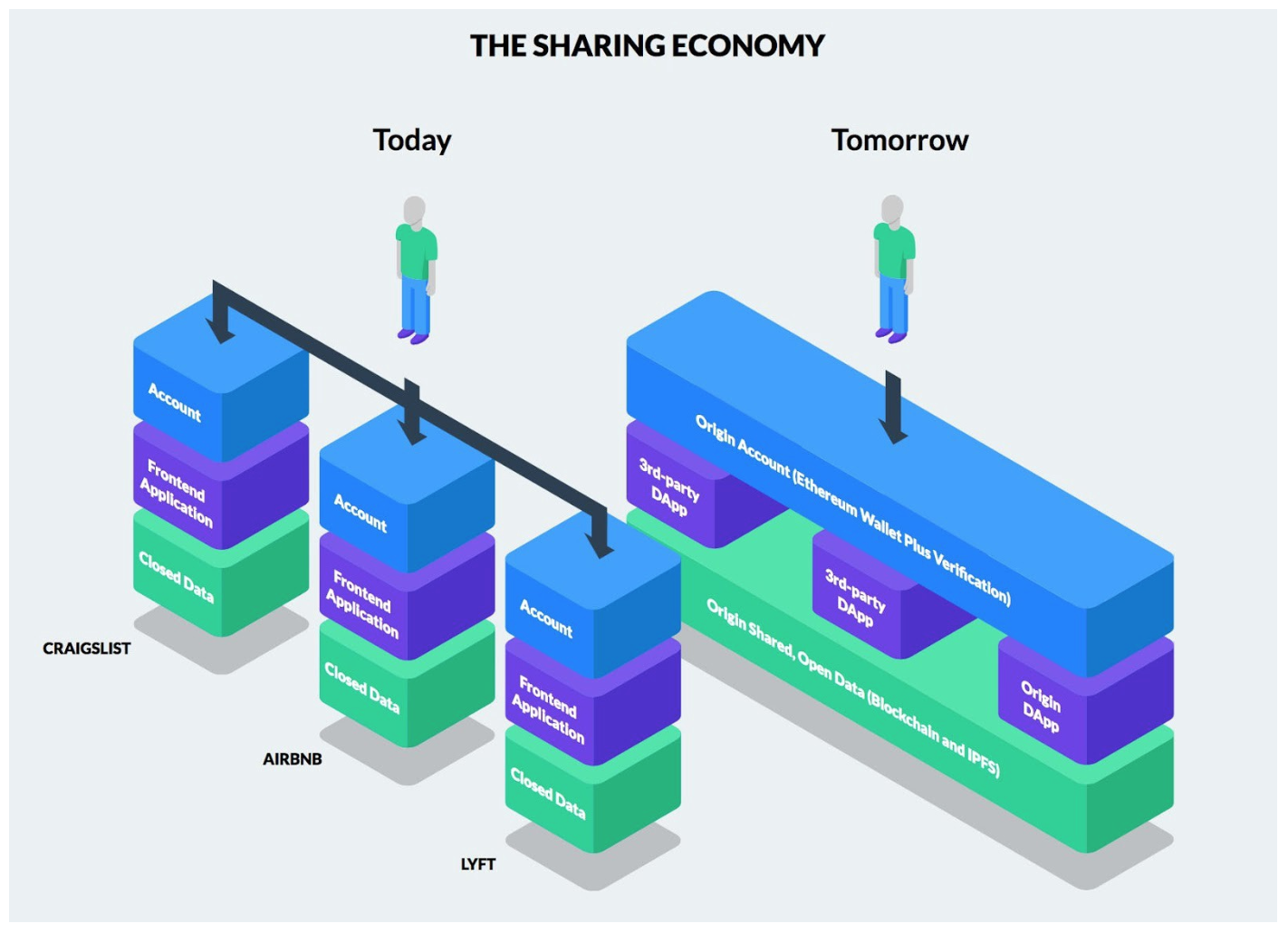
As we’ve noted, platforms are benefiting from levying fees from the users – who are in this case both the suppliers and consumers. As history shows in any economy, startups with disruptive business models will always cement a firm footing. But in looking at the landscape of the sharing economy we should look beyond just business models but at technologies that aim to increase the power of users. Most notably, looking at blockchain. Blockchain essentially provides framework to cut out the middleman, and provide transparency and enable easy peer-to-peer interactions without the 20-30% transaction fees firms typically apply (Thellman, 2018). In fact, we’re seeing an emergence in startups building frameworks for others to build their sharing platforms on top of.

Infographic sharing what a decentralized sharing economy looks like (Source Origin Protocol https://www.originprotocol.com/en)

Infographic sharing what a decentralized sharing economy looks like (Source Origin Protocol https://www.originprotocol.com/en)

As we’ve seen in the case of Shopify and Squarespace, platforms that democratize their expertise and empower others to start their own businesses do very well and command a lot of power in the economy. As this is a recent trend, this field should be watched closely in the near future as first mover advantage has proven time and time again to be extremely powerful.

Additionally, as we’re seeing across markets, new and better AI seems to be a challenger of current platforms. For example, we’ve made it clear that the sharing economy is about access to excess supply, but we may need to look even deeper. In the case of Uber and Lyft, the excess supply is governed two-fold; by excess supply of the car but also the time allowance of the driver. Tesla are moving into the sharing economy by building their “Tesla network”, taking advantage of excess supply of cars without compromising the time of the driver by using the autonomous nature of the car to pick up and drop those looking for rides (Korosec, 2019). In this case, consumers are indirectly influenced in their purchasing decisions by AI, as they start to look at their new cars as assets and investments.

Again, the point is not to look to blockchain and AI as the future of the sharing economy but provide an example to the point that we should keep a close eye on what emerging technologies are doing to disrupt the playing field. In the case of blockchain, what is happening to give more power to users. Harvard Professor Samer Hassan, in his research claims blockchain can help sharing economy projects to overcome several challenges they face at infrastructure, governance and economic levels” (2018). For AI, we can look at asking questions along the lines of what opportunities are there to connect not just those with ownership of the resource to those seeking access, but also extend a more complex equation, to those with excess time, without the resources and provide a match to resources they can rent to further rent to others for their gain.

Working with Regulatory Entities

Working with governments and regulatory entities will be crucial. Government intervention, both supportive and regulative, will be critical in the near future when building up of the sharing economy. While we’ve noted that sharing is not a new concept, the extent to which it is scaling and its effect on workers has governments worried.

What we have seen so far with the sharing economy – and to an extent, technology – is that it has advanced beyond understanding and grasp of current decision makers. As governments worldwide deal with the state of their troubling economies, externalities from the sharing economy are seen not as a byproduct of poor economic growth and stability, but are seen as a cause. Regularly the terms “gig economy” and “sharing economy” are used synonymously when they are different concepts with a certain amount of overlap. As such, it’ll be important to develop and provide frameworks, understandings, and rationales to policy makers so they have a better understanding of the market. Furthermore, they can work to incorporate as opposed to challenge the platforms. The World Economic Forum in 2017 provided research helping international agencies and entities understand the differences between “similar emerging concepts” and the sharing economy especially in how these concepts manifest themselves in urban communities. In the next three years as key players in the world economies are hosting national elections with potential for big changes in leadership, it may be wise for marketers to start incorporating government organizations in their strategies and sharing their knowledge to keep them better informed as they move towards new policies.

Implications of Coronavirus and the societal changes

When I was initially putting together this study, it was a time when a novel respiratory flu-like disease was not affecting every industry on the planet. It seems likely that the world will bounce back from Covid-19, but with some dire economic consequences for firms of all sizes. While I think some of my initial thoughts are still relevant to the future of the sharing economy, I can’t help but wonder about the societal and cultural effect months of social distancing will have on our concept of “sharing” with others. Will we exit this to a future where we have no qualms about working side-by-side with strangers at a WeWork? Or sit next to someone you’re picking up in your car to earn a little on the side? Would there be some trepidation on our part in borrowing items handled by others with no record of who? I would be remiss if I didn’t consider these issues in a study.

My view is that the sharing of ones excess supply will continue to be a way for us to share the benefit and the value of our assets. With an added incentive of being able to monetize this shared value, it’ll only continue to be more and more important to us as we enter what seems like another economic downturn. That being said, it’ll be increasingly important for individuals and platform enablers to be able to verify the usage and ensure the security of users. Blockchain at its heart aims to provide better, more secure peer-2-peer interaction. Firms like Origin Protocol who were early movers in this field might just see their value proposition become more attractive as the months go on.

On the flip side however, we may have to accept a ‘de-volution’ back to ownership of assets. But as affordability becomes less, will we see a shift towards modular solutions? And as we’ve seen with gig workers unable to access health insurance or benefits, will we start giving more power to those who own and share their assets eliminating the ‘gig’ aspect of the equation? I don’t know what this future looks like. But with it may come the change that labour economists have been looking for and maybe that’s a good thing. The demise of the gig economy and the rise of a more secure sharing economy with power in the hands of the prosumers. Wouldn’t that be something.

Final Thoughts

The sharing economy is here to stay, not as a separate entity but in many ways now part of the economy. The ones who stand to make the most impact and be helpful in guiding the future will embrace new technologies that reduce friction between players and continue to use new data to challenge industries and see what new resources can be shared. Time and time again, we are seeing first mover advantage play the most important role in cementing a footing in the industry and in my opinion the next 3 to 5 years will be crucial in laying the path for the future. Identifying the underlying principles guiding the sharing economy, working with regulatory agencies and deploying disruptive strategies incorporating new technologies will be the steps to take.

Deep Work by Cal Newport - Notes for Focussed Success /  by Usamah Khan

Photo by Carl Heyerdahl on Unsplash
 
Deep work.jpg

Do you ever have those moments during a project when you’re so focussed, the ideas are flowing and you seem to be making constant progress? Some people call this being in flow and while it’s probably the best feeling to have in your professional life, replicating the feeling and the focus can be one of the most difficult tasks. But some people who have identified the factors that lead to this state can and have made a habit out of this style of working. Cal Newport is one of those people and calls this state “Deep Work” and was kind enough to do research and outline some of the guidelines to developing this habit.

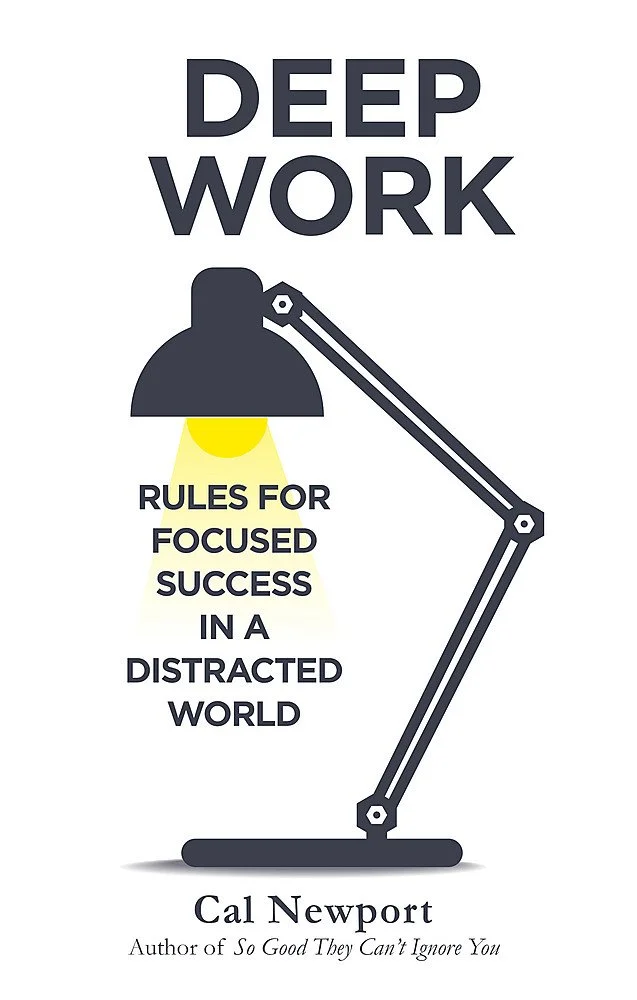
Over the past few weeks I’ve made my way through Newport’s Deep Work and it’s been one of the most eye-opening and impactful reads of my professional life. At first glance it - especially with the subtitle of “Rules for focused success…” - it can seem like your average “10 ways to make you smarter and more successful” self help book but its really actually anything but.

This is not a set of rules to achieve more productivity - this could get tiring, be too rigid and ultimately not something that has the potential for any long term hold or impact on you. It’s more an exploration of focus as a concept and a practice. By examining high achievers in different fields and their habits and lifestyles, Newport has synthesized common threads and strategies used to achieve a high level of focus and a habit of “deep work” resulting in output of true value. Which is I think what we all hope to produce in our professional lives.

With the framework and guide laid out in here, Newport manages to put forth a convincing argument as to why deep work is important while giving you a whole toolkit to start making changes to how you approach work.

Probably the most impressive aspect of his research, is that Newport acknowledges the fact that some of these techniques are specialized, and will only work for some people. Yet, to be relatable to audiences with different backgrounds and priorities he lays out choices resulting in not a doctrine, but a framework with only a four simple rules to adhere to.

I think for me to apply these techniques to my life it’s going to take time, practice and understanding of my mental capabilities. Luckily I kind of realized this early on in my reading and decided to take some notes summarizing aspects of the different chapters, extracting what resonated most with me and adding my thoughts. This started just as a way to keep up and refresh myself every time I thought to experiment with a technique, and it’s proved to be helpful. So I figured I’d clean my notes up a little and share them here.

If you haven’t read the book, I would highly suggest you do so. These notes, while in some places convey important points from each chapter, are in no way a substitute for the book. Newport really goes in with his stories and anecdotes and they are crucial to getting the most value out of this book. That being said, I do go over all of the concept outlined and so if you’ve read it, listened to the audiobook or are curious and have an interest in honing your mental capabilities to achieve depth in your professional life I hope this can help brief and remind you of some important concepts and techniques like it does for me.

As always, feel free to get in touch! While it may go against some of the principles outlined in this book, I think as I’m starting to change how I approach my work, I’d love to hear stories from others who have embraced the philosophy of Deep Work. Without further ado, here are my notes. I have them here, but also on a shared doc if you’d like to make comments or duplicate for your own needs.

Note: Just want to be clear that these my notes on the book. Because of how succinct and well written it is, some phrases and quotes may appear verbatim or with slight changes. I have no intention of passing any of it off as my own. I’ve done my best to highlight quotes wherever I’ve included them and if I have an opinion I preface it with “I think” or something of the sort.


RULE #1 - WORK DEEPLY


Newport outlines certain behaviours and mindsets to adopt that give rise to deep work.


Decide on a Depth Philosophy

Four different philosophies of deep work scheduling, some with overlap, are given with examples of high performers who embrace each.

Monastic philosophy

Maximize deep efforts by eliminating or radically minimizing shallow obligations

Donald Knuth of Stanford CS famously has been email free since 1990, Neal Stephenson doesn’t attend speaking events or have an email either. This method aims to focus truly on what’s important and shut off from a lot of ‘trivial’ distractions in life.

Bimodal Philosophy

Divide your time, dedicating clearly defined stretches to deep pursuits and leaving the rest open to everything else.

Freud used to do this by retreating to his cabin outside Zurich to do work but regularly filled his time with patient work and frequenting coffee houses to talk with other philosophers, debate new ideas and understand more of what he needed to explore to challenge other philosophies of the age. Adam Grant as well, he spends one semester a year teaching, the other working one publishing. These are people who respect the monastic way of deep work but respect the value they receive from shallow behaviours.

Rhythmic philosophy

Integrate depth into your life by transforming them into a simple regular habit.

Seinfeld and his ‘chain’ method. Write a joke every day, and mark a big red X on the calendar every time you do. “The chain will grow longer every day. You’ll like seeing that chain especially when you get a few weeks under your belt. Your only job next is to not break the chain.” So make it a habit, set a schedule for your deep work sessions. Similar to bimodal but not at so much of a mutually exclusive level. It may not be as deep but works well with human nature. Those who incorporate deep work with a regular rhythm and rock-solid routine can often log a larger number of Deep work hours per year.

Journalistic philosophy

Fit deep work wherever you can in your schedule.

Often this is the type of work employed by high output journalists operating under deadlines and so on. Difficult to do as getting into flow takes time. Often this method is for those who are well versed in the concepts and practices of Deep work.


Ritualize.

The next important step is to create rituals. Take the quote - “great creative minds think like artists but work like accountants”

An effective ritual needs to address the general questions:

Where will you work and for how long?

Specify a location and time frame to keep the session a discrete challenge and not open-ended.

How will you work once you start to work?

Set rules and processes such as internet/phone ban, or maintain a metric such as words/lines of code written in the session. Without this structure you’ll have to decide what and why are you working on this or are you working sufficiently hard. This diminishes willpower reserves.

How will you support your work?

Ensure your brain gets the support it needs to operate at a high level of depth. Start with a fresh cup of coffee/bottle of water or integrate light exercise like walking or stretching to keep everything going.


Make Grand Gestures

While finishing the Deathly Hallows, J.K Rowling was finding it distracting at home so spent $1000 a night at Balmoral hotel to finish. Leverage a radical change to your normal environment, coupled with a significant investment of effort or money, all dedicated to supporting a deep work task. Doing this increases the perceived importance of the task. Think also Bill Gates “Think Weeks”


Don’t work alone

Collaboration, even in passing conversation with others outside your field, helps to stimulate new and fresh ideas. Try to cultivate “the whiteboard effect”. For certain problems, when working with someone else at the proverbial shared whiteboard, you can push yourself deeper than work alone. Just by the presence of another party waiting for your next insight and “short circuit the natural instinct to avoid depth”


Execute like a business

Adapted from “The 4 Disciplines of Execution” or 4DX

#1 Focus on the wildly important

The more you try to do, the less you will accomplish. “Don’t try to say no to the trivial distractions but say yes to the subject that arouses a terrible longing and let that longing crowd out everything else.”

#2 Act on Lead measures

Lag measures are those in retrospect - how happy are your customers? You generally find this out after a survey whereby action has no more effect. Lead indicators are initiatives that can improve immediate happiness - e.g. free samples at a bakery - that will have an effect on lag as well.

#3 Keep a compelling scoreboard

Keep a record of the work. How many deep work hours a day and circle hours where a breakthrough or particularly useful insight occurred. This way you can measure how many hours between breakthroughs, achievements per day etc. Helps calibrate expectations of deep work to output.

#4 Create Cadence of accountability

Review each week t regular intervals where you are, what was good, what was bad and plan for the next week. Looking at scoreboard can help understand the factors of what leads to a good week.


Be lazy

Lastly, take rest.

Reason #1 Downtime aids insights

Rely on the subconscious mind to understand difficult problems and mull them over. Deliberate thinking leads to overthinking and as such hinders your cognitive ability to make sense of a particularly difficult issue.

Reason #2 Downtime helps recharge the energy needed to work deeply.

To concentrate requires direct attention and attention is finite. So by limiting the attention you give, you can restore the ability to direct your attention. So try to shut down. Work in the evening or after work hinders the ability for you to do good work the next day.

Reason #3 The work that evening downtime replaces is usually not that important.

Generally, people have between 1 - 4 hours of deep work in them a day (novice to expert). By the time the evening comes, the work you fit in won’t be the high-value activity that really advances your careers but shallow tasks executed at a slow, low energy pace. By deferring work you’re not missing out on much importance.

Implement a shutdown ritual

The reason shutdown is hard is because there are always incomplete tasks and work to be done. But its a case of good high value/quality work that’s important, and that requires a shutdown.

This doesn’t work by simply stating at 5 pm “I’m done with work until tomorrow”  though. A ritual needs to be in place. By taking inventory of completed tasks and incomplete tasks and committing to a specific plan for a goal not only facilitates the attainment of the goal but frees cognitive resources for other pursuits.

“When you work, work hard. When you’re done, you’re done.”


RULE #2 - EMBRACE BOREDOM


The ability to concentrate is less a habit but more a muscle that needs to be worked out and developed. Take for example the Jewish practice of studying and deciphering a page of the Talmud every morning. This intensity of thought every day helps those who study in more ways than just adding knowledge to their lives. The mental exercises help with creativity and so on so forth. The “consistent strain has built my mental muscle over years and years. This was not the goal when I started, but it is the effect.”

The idea and practice of being able to concentrate on one thing fully is important to develop the skills required for deep work. The main problem lies in our need to switch attention at all times. Check our email, our social media etc. But this constant switching is weakening our abilities to stay concentrated.

People who multitask all the time can’t filter out irrelevancy. They can’t manage a working memory ... They are chronically distracted … they’re pretty much mental wrecks ... The people who we talk with continually said “look, when I really have to concentrate, I turn off everything and I am laser-focused.” and unfortunately they’ve developed habits of mind that make it impossible for them to be laser-focused. They’re suckers for irrelevancy. They just can’t keep on task.”

To practice, need to embrace boredom like not looking at your phone while waiting in line or at a restaurant. The following roadmap helps.


Don’t take breaks from distraction. Instead, take breaks from focus.

Schedule internet or network time. and make sure that your network/smartphone etc time comes only during those blocks.

Consider 3 points.

Point #1: This strategy works even if your job requires lots of Internet use and/or prompt email replies.

If your work requires a lot, schedule more blocks, but the act of resisting the need to check strengthens your resolve over time.

Point #2: Regardless of how you schedule your internet blocks, you must keep the time outside these blocks absolutely free from Internet use

If you are caught in a task that absolutely requires internet knowledge such as from an email, message etc. - either move from said task to something else to fill the time or take a break. If you absolutely need that information, schedule a new time, but not immediately - say in 5 mins. Even the act of resisting then is powerful.

Point #3: Scheduling Internet use at home as well as at work can further improve your concentration training.

If you find you spend a lot of time evenings on smartphone/internet, consider scheduling the time to help build concentration.

To succeed with deep work you need to rewire your brain to be comfortable resisting distracting stimuli. No need to eliminate distracting behaviours, but eliminate the ability of such behaviours to hijack your attention.


Work like Teddy Roosevelt

Teddy Roosevelt had so many eclectic interests during his time at Harvard that he spent a lot of time on. However, he knew he needed school so he spent a quarter of the day studying but knowing that was his only time to study, he did nothing else. Incorporate “Roosevelt dashes”. Take a task, and if you know the time it will take you to complete it, drastically reduce the time and put an artificial deadline on it. This way you leave no time for distractions and have to strengthen your mind to perform a task at hand.


Meditate Productively

Activities such as running/walking/cycling/commuting provide time for productive meditation. Take a period where you are occupied physically but not mentally and use that to think hard about challenges you are facing at work etc. Some suggestions:

Suggestion #1: Be wary of distractions and Looping

Some thoughts that are normally mundane such as drafting an email to someone can take on huge importance. Remind yourself that you can return to that thought. And don’t get caught in a loop of going over what you know to procrastinate thinking further.

Suggestion #2: Structure your Deep Thinking

Think of frameworks and what you want to achieve. Much like how you structure the framework for a deep working session, carefully review what are the relevant variables for solving the task and specify next-step questions,


Memorize a deck of cards

Mental athletes employ different techniques to strengthen their memory. By doing so they improve the overall mental muscle through the act of putting strain on the brain. There is a passage on how to memorize a deck of cards but this activity can be substituted with something else that requires similar levels of focus and association - the best example being, learning a song by ear


RULE #3 - QUIT SOCIAL MEDIA


In 2013 Baratunde Thurston went off the grid for 25 day - a complete shutdown of social media. Fast Company wrote an article about it called #Unplug. Of course for the purposes of running businesses and marketing a book, he had to return but he made two important points about our relationship with social media (Facebook, Twitter, Instagram) and infotainment sites (Buzzfeed, Business Insider). These two categories of online distractions are known as “network tools”.

Point #1

We increasingly recognize that these tools fragment our time and reduce our ability to concentrate. Making an effort on the strategies in the previous chapter will be significantly more difficult if you behave like Thurston pre-experiment. To master Deep Work, need to take back control of time and attention from the many diversions that attempt to steal them.

Point #2

The impotence with which knowledge workers currently discuss this problem of network tools and attention.  Overwhelmed by this sometimes the only option is an “internet sabbatical”.

However this binary view is not entirely helpful, maybe there needs to be a middle ground. Accept that these tools can be vital to success and happiness but at the same time accept that the threshold for allowing a site regular access to your time and attention should be much more stringent.


How to find the middle ground?

First, try to acknowledge what camp your tool selection falls under.

The Any-Benefit Approach to Network Tool Selection:

You’re justified in using a network tool if you can identify any possible benefit to its use, or anything you might possibly miss out on if you don’t use it.

There are issues to this approach as it ignores all the negatives that come along with the tools in question. If you don’t attempt to weigh the harms against the benefits, then any small benefit will be justified. We’re comfortable with this approach but if we zoom out and view it in the same way we would any other tool kit we possess, it seems bizarre to take this approach. We use tools, and if the tool only has a slight benefit, why would we use it? Skilled labourers apply sophistication and skepticism to encounters with new tools and their decisions about whether to adopt them. Consider doing the same for your choice of Social Media.

The Craftsman Approach to Tool Selection

Identify the core factors that determine success and happiness in your professional and personal life. Adopt a tool only if its positive impacts on these factors substantially outweigh its negative impacts.

This story was really insightful to me so I included it in some detail. This part of the summary may be a bit long, but hope it resonates with you like it does with me.

Consider Forrest Pritchard who runs Smith Meadows farm. When he took over, the farm made its own hay to use as animal feed during the cold winter months. This also required the use and upkeep of a hay baler. The idea was why spend money to buy from another farm when you have perfectly good grass that you could use yourself? If you applied the any-benefit rule then it’s easy to see how compelling this argument is. However, Pritchard looked at it from a different perspective.

He looked at the costs of making hay. Monetarily you have to take into account the cost of the machine, fuel, repairs, and the shed to keep the baler. Not to mention taxes on the baler. These costs can be directly measured. However, there are costs that are harder to measure. Such as the time it takes to spend a summer making hay, as well as the constant driving over the land that compacts the soil.

These are all opportunity costs because by simply removing hay production from the equation Pritchard could raise chickens instead during the summer that he could sell to provide for the farm as well as use the manure for fertilizer. He then realized that by buying hay his money was actually being used two-fold; it would provide food for the animals and when the food passed through the animal it would provide manure and fertilizer for the farm. So he concluded that buying hay results in healthier fields and “soil fertility is my baseline”. By calculating this, he realized the hay baler had to go.

So with that, look at your network tools and give them a measured & nuanced look at that tools in all other trades are subjected to. Identify what matters most in your life and then you’ll realize that just going on “it’s useful, keep it” starts being an ineffective way of introducing and using tools in your life. Once you have control over this, you’ve taken back time and attention that you can use to help with the rest of the strategies in this book. By this reasoning, don’t go after shiny new things without weighing the pros and cons.


Strategies to abandon the Any-Benefit approach for a more nuanced Craftsman Approach

Apply the law of the Vital Few to Your Internet Habits

Malcolm Gladwell, Michael Lewis and George Packer - all accomplished writers, don’t use Twitter. While Some writers such as David Carr take a pro-Twitter stance making statements such as “I get a sense of the day’s news and how people are reacting to it in the time that it takes to wait for a coffee at Starbucks” Gladwell, Lewis, and Packer don’t feel like Twitter offers them nearly enough advantages to offset negatives. Lewis says it saps his energy and “it’s amazing how overly accessible people are. There’s a lot of communication in my life that’s not enriching, it’s impoverishing.”

While the success of the three authors speaks for itself in their choices to remove Twitter from their lives, for knowledge workers this becomes a little harder to pick apart.

Step 1 - Identify high level goals in your life, both professional and personal.

This could be very different. If you’re a parent, time with kids or keeping an orderly home may be crucial. Or as a teacher, writer or developer, having a steady stream of quality output and be effective in your workplace. Set your goals but keep them fairly high level. If you’re too specific you can overcrowd your mind with goals.

Once you’ve identified these goals, list 2 or 3 important activities that can help you satisfy this goal. Now is the time to get specific, identify what to do that is repeatable and measurable. “Do better research” is too broad, “finish paper for the seminar” is too specific. “Regularly read and understand cutting edge technology in my field” is best.

Step 2 - Consider the tools you currently use

Ask yourself whether the use of a tool has a “substantially positive impact”, “little impact” or a “substantially negative impact” on your regular and successful participation in the activity. Keep using the tool only if you conclude that the substantial impacts outweigh the negative.

Examples of goals and key activities

Professional goal: To craft well-written, narrative-driven stories that change the way people understand the world.

Key activities that support this goal:

  • Research patiently and deeply

  • Write carefully and with purpose.

Now, does using Twitter help this? Does it allow time for patient and deep research or does it serve as a distraction. Same for writing. Is tweeting careful and purposeful? Weigh the pros and cons and determine for yourself whether the benefits are directly in line with your goals.

Personal goal: To maintain close and rewarding friendships with a group of people who are important to me

Key activities that support this goal:

  • Regularly take the time for meaningful connection with those who are most important to me (e.g. a long talk, a meal, joint activity)

  • Give of myself to those who are most important to me (e.g. make nontrivial sacrifices that improve their lives)

Does Facebook help you with any of this? How meaningful are the connections you make via Facebook? Is there room to give and help a friend in need? Newport says no and is his reason for leaving Facebook. Personally, I have close friends all over the world and keeping in touch is important to achieve my goal of maintaining close friendships. However, Facebook doesn’t help with this but having the Messenger app helps me keep in touch despite changing numbers and locations and im able to maintain a connection that facilitates meeting up and making time for each other. So I choose to remove half the Facebook equation from my life.

The Law of the Vital Few: In many settings, 80% of a given effect is due to just 20% of the possible causes.

All activities, regardless of their importance, consume the same limited store of time and attention. If you service low-impact activities, you are taking time away from high-impact activities that offer substantially more rewards per unit of time. Therefore, invest in higher activity and increase the benefit.

Quit Social Media


Stuff accumulates in people’s lives because of the worry of “What if I need this one day”. Ryan Nicodemus had a system for identifying and getting rid of the things in his life that he didn’t need. He packed up all his things in boxes and for the next 30 days, if he needed something, he went to the box, got it out and whatever was left in the box at the end of those 30 days, he realized wasn’t adding much value to his life.

Apply this to your social media choices. Take a hiatus from all social media for 30 days. Don’t deactivate and don’t announce (important), just stop using. After 30 days of this ask yourself two questions about each of the services you quit.

  1. Would the last thirty days have been notably better if I had been able to use this service?

  2. Did people care that I wasn’t using the service?

If the answer is “no” to each of the questions, drop it. Otherwise, examine your time and decide for yourself.

The key is to free yourself from the convincing marketing at the center of all these platforms which is if you don’t use them you might miss out. Once you go through, you can determine for yourself if you really did miss out.

Lastly, just an interesting note on the interactions on social media. If you have 200 followers on a platform, it can be easy to believe that your activities on these services are important because people volunteered to hear what you have to say. But think of how you get new followers. You follow someone and they in turn follow you. You trade likes to keep engagement up.

“I’ll pay attention to what you say if you pay attention to what I say - regardless of its value”

By dropping off these services, you can test the reality of your status as a content producer.

So by taking a hiatus, this experiment should give a more grounded view of the role social media plays in your daily existence. Maybe you find they’re derailing you from important things, maybe they are at the core of your existence. Either way, you won’t know until you try life without them.

Don’t Use the Internet to Entertain Yourself

Arnold Bennett - an Early twentieth century English writer - wrote about the new class of the “White collar worker”. It was at this time when it became possible to have a job where you spent a set amount of time in an office and received a steady salary in return - the now typical 8 hour work day.

Bennett noted that beyond the 8 hours people were working, they had about 16 hours left in the day. However, he saw that many people didn’t recognize it’s potential. He said in his 1910 self help classic, “How to live on 24 hours a day” that

“The great and profound mistake which my typical man makes in regard to his day is even though he doesn’t enjoy his work and see it as something to get through, he persists in looking upon those hours from ten to six as ‘the day’ to which the ten hours preceding them and the six hours following them are nothing but a prologue and epilogue. This is an attitude that is utterly illogical and unhealthy”

He suggests looking at those sixteen hours as a “day within a day” and spend it as an aristocrat would - performing rigorous self-improvement - a task primarily involving reading great literature and poetry.

This is a little antiquated but the idea of doing something structured and productive like reading, or a sport or class, or even spending time with a friend is better and more productive for the mind and soul than spending your leisure time on clicking and surfing through least common denominator digital entertainment. You’d likely fall into despair at the lack of progress in this area of human development.

So try to set some time, no internet, read a book, have an activity, I’d say play a video game - Newport may disagree - but as long as it’s deliberate and with determination, it’s better than  giving your attention to social media designed to grab your attention and keep you on. Also, remember to embrace boredom. If you’re in the line at the store or on the bus etc. don’t fall back to social media to give yourself something to do.

“One of the chief things which my typical man has to learn is that the mental faculties are capable of a continuous hard activity: they do not tire like an arm or leg. All they want is change-not rest, except in sleep”


RULE #4 - DRAIN THE SHALLOWS


Just one note before I continue summarizing this chapter. It seems that the ideas strategies here pertain to people who are advanced in their careers. While the techniques earlier on may apply to entry level workers, some of the advice here - especially later in the chapter - I think would resonate more strongly with those who have experienced a decent amount of success and are fighting off distractions.

Consider 37signals (now called Basecamp). They launched an experiment shortening their workweek to four days. Upon its success, they made it permanent between the months of May and October. While there was criticism calling into question the effectiveness of of cramming 40 hours into 4 days, co-founder Jason Fried responded and said that wasn't the point. The point was that by limiting the working hours, employees were still producing at the same output. How? Well as Fried put it

“Very few people work even 8 hours a day. You’re lucky if you get a few good hours in between all the meetings, interruptions, web surfing, office politics, and personal business that permeates the typical workday.

Fewer official working hours helps squeeze the fat out of a typical workweek. Once everyone has less time to get their stuff done, they respect that time even more. People become stingy with their time and that’s a good thing. They don’t waste it on things that just don’t matter. When you have fewer hours you usually spend them more wisely.”

37signals took this a step further, and every year give their employees one month to work on their own passion projects. No meetings, emails or anything, just work. So many great ideas come from it that Fried asks:

“How can we afford to put our business of hold for a month to ‘mess around’ with new ideas? How can we afford not to?”

This leads to the main point of the chapter. Eliminate the ‘shallow’ work from your day to day and see how much more you can get done in your limited time. Deep work takes cognitive capacity and the most effective deep workers can manage max about 4 hours. But with shallow work, that even may be hard to achieve with the other 4 hours broken up.

Shallow work is necessary in a lot of knowledge work but keeping it monitored and confined is key to taking full advantage of the hours in your day. Below are some strategies to help with that.


Schedule Every Minute of Your Day

Newport’s suggestion is at the beginning of the work day, turn to a new page of a lined notebook, mark an hour on every other line and make chunks of time to plan your work in min 30 min segments.

No need to be hyper specific. Have a task list of work that needs to get done - such as emails, reviews, planning etc. - and set up “task” chunks as well as “deep work” chunks. Block off rest, lunch and recreation as well, but just be mindful of what it is you’re going to be doing at all times.

So now, here’s where two things will go wrong. First, thing is your estimates will prove wrong. Second, you will be interrupted and new distractions will come up. This is fine, just note it, and update, move the blocks up or around if a shallow task has an urgency to it.

The goal is not to stick to a given schedule at all costs but instead maintain a thoughtful say in what you are going to do with your time.

What if schedule revisions become overwhelming?

Recognize that you will almost definitely underestimate the time required for most things

Just move forward and understand where you allocated less time or more time and be sure to understand yourself and push yourself as time goes on.

Use overflow conditional blocks

Allocate more time than needed for a task but do so in a block that can be repurposed for other tasks if not needed.

Be liberal with your task blocks

Deploy many during the day and make them longer than required to handle the tasks you plan to do.

Lastly, be mindful that this isn’t something to stick rigidly to. If a moment of inspiration or an interesting thought comes to you. Follow it through. It is a perfectly valid reason to ignore the schedule and you will be happier for it. Just remember that once that loses steam, go back to your schedule and rebuild it for the rest of the day and the tasks needed. Just be sure to mindful and treat your time with respect.

“You must overcome your your distrust of structure if you want to approach your true potential as someone who creates things that matter”


Quantify the Depth of Every Activity

Consider your tasks and ask yourself a question - “How long would it take (in months) for a smart recent college graduate with no specialized training in the field to complete this task?”

The point is not to train a student to do your work but understand what takes the years of knowledge, experience and expertise you have to do. When you determine this, you can understand what is it in your work that leverages expertise and leads to deep work with value. When you find that out, you can allocate time accordingly which leads to the next point.


Ask Your Boss For a Shallow Work Budget

So this here is answering the question “What percentage of my time should be spent on shallow work?”. Part of the reason shallow work persists in large quantities in work is we rarely see the impact of sch efforts on our schedules.

By measuring this, you can take this to your manager and say “This is how much time I spent on shallow work last week” and get an approval for that ratio. Faced with these numbers and the economic reality that it is wasteful to pay a highly trained professional to send e-mail messages, they will be forced to come to the conclusion that you just need to say no to somethings and streamline others. With this, you and your manager have an understanding of what you can afford to put aside for work that keeps the gears moving and what it takes to create something of value.


Finish Your Work by Five Thirty

Work by a commitment to your day called “fixed-schedule productivity”. Similar to the way Teddy Roosevelt worked in Chapter 2 - Limit your work week - say to 50 hours - and work backwards to determine what rules and constraints are needed to fulfill this.

Consider Radhika Nagpal of Harvard University who implemented this in her life. She made ‘sacrifices’ - limiting the amount of travel per year to 5 times (average for an academic is 12-24 times!) and placing a limit to the number of papers she would review. Taking that time back allowed her mind to refresh, give her time for deep work and produce more in less time while other professors were working evenings and weekends.

Be wary of ‘yes’ when giving your time. By doing this you become wary of engagements that are shallow and suddenly any obligation beyond your deepest efforts is suspect and seen as potentially disruptive.


Become Hard to Reach

Need to turn the attention to email since it’s so ubiquitous and one of the most shallow activities. It’s a necessary tool for much work and if you aren’t like Donald Knuth and can switch off email entirely, there are some ways to put some barriers up.

Tip #1: Make People Who Send You Email Do More Work

Set up a sender filter. Connecting with people should be something enriching and enlightening. Wherever you have your email out there, set up expectations such as Newport’s “I’ll respond to proposals that are a good match for my schedule and interests”. This makes a difference in how correspondents think about their messages to him.

Similarly, Antonio Centeno - who runs Real Man Style blog - employs a two-step process. If you have a question, he diverts you to a public location as he believes it wasteful to answer the same questions again and again. Secondly, if you make it past this point, he makes you commit to checking 3 boxes

  1. I am not asking a question that I could find searching on Google for 10 mins

  2. I am not SPAMMING with a cut and paste generic request to promote my unrelated business

  3. I will do a good deed for a stranger if responded to in 23 hours


This is just an example of how if you are able to do so, you can reclaim some control over your time and attention.

Tip #2: Do More Work When You Send or Reply to Emails

Consider the common cookie cutter emails of work

  • “Do you want to grab coffee?”

  • “We should touch base, remind me where we’re at?”

  • “Wrote this, thoughts?”

How you respond to them will have a significant impact on how much time and attention the resulting conversation ultimately consumes. By firing off a quick email you save time in the moment but set yourself up for follow-ups that go nowhere.

So, before you respond take a moment to answer the following key prompt:

What is the project represented by this message, and what is the most efficient (in terms of messages generated) process for bringing this project to a successful conclusion?

Make your responses process centric. So for the common emails above try something like:

  • “Sure lets grab coffee, I’m available Tuesday and Thursday at these times, I’ll consider your reply a confirmation, if that time doesn’t work, give me a call”

  • “I agree, my suggestion, send me your notes, I’ll add what I remember in a shared doc, we’ll review and let’s meet in a month at this time”

  • “Thanks, I’ll read this, annotate it and send it back by Friday. You should have enough to go on, no need to reply or follow up unless there’s an issue”

Note these are highly condensed but I would argue, quick responses that are actionable and process driven.

Tip #3: Don’t Respond

If you don’t make a convincing case and sufficiently minimize the effort required by someone to email back, don’t expect a response. Same goes for your inbox.

Since Newport is a professor, this relates more to academics but, do not respond to an email if any of the following applies:

  • It’s ambiguous or makes it hard to generate a reasonable response

  • It’s not a question that interests you

  • Nothing really good or bad would happen if you did not respond

There are exceptions, but these are good guidelines for reclaiming your time. Some bad things will happen of course, but as Tim Ferris puts it

“Develop the habit of letting small bad things happen. If you don’t, you’ll never find time for the life-changing big things.”


CONCLUSION


There’s more philosophy and examples of great focussed workers, but I think the last paragraph of the book sums it up better that I could (sic):

“If you’re willing to sidestep comforts and fears, and instead struggle to deploy your mind to its fullest capacity to create things that matter, then you’ll discover, as others have before you, that depth generates a life rich with productivity and meaning. Winifred Gallagher said “I’ll live the focused life, because it’s the best kind there is”. I agree. So does Bill Gates. And hopefully now that you’ve finished this book, you agree too.


MY ADVICE


So with that, I hope you find this useful. From my experience experimenting and applying some of these techniques to my life, I would offer the advice to take it slow. Much like with any muscle you’re trying to build, whether it’s trying to play a tough riff or solo on the guitar or training to run a marathon, take it step by step. Try out small chunks, figure out what is having a positive effect on your life and once it becomes a habit, keep layering and building on top of it. For me, I’ve found keeping a timer and quantifying how long I spend on tasks as well as Seinfeld’s chain method has really resonated with me. I was able to apply those techniques to study for an exam - something I haven’t done in four years - and be comfortable and confident in what I learned and get a grade I’m really happy with. See what works best for you.

Thanks for stopping by and always feel free to get in touch!