reflection

Opportunities for IoT and a Connected Future /  by Usamah Khan

Photo by BENCE BOROS on Unsplash

Photo by BENCE BOROS on Unsplash


When I think about the future, I get most excited about the potential of the Internet of Things (IoT). It represents a step forward for connectivity and brings with it a whole host of new and exciting possibilities. With billions of devices around the world connected and sharing data, from fridges to air quality sensors, the world around us is becoming smarter, responding to our needs in intelligent and deliberate ways. Working in the IoT space for over 3 years now, I’ve developed a pretty good feel for how to access and make sense of open-source IoT data, and what kind of products can be built harnessing the data. However, recently I’ve been curious and drawn towards what opportunities are out there and overarching strategies companies need to take to jump on the IoT revolution. With 5G just around the corner, enabling faster connectivity and possibilities for IoT, I think no matter what the industry, it will be more and more crucial to have an understanding of the underlying technologies and the opportunities associated with it.

So with that, I collected my thoughts and wrote this with the aim to understand and explain the market opportunities within IoT and the end value it can bring to firms. Furthermore, I’ve pieced together my own ideas on what I think are some strategies to take if you’re thinking of starting an IoT company or for organizations looking towards a connected future.


A CONNECTED FUTURE


IoT has cemented its place in the world but 5G is the next frontier. Boasting faster speeds and lower latency, 5G stands to change the landscape for consumers but more importantly, industries such as healthcare, manufacturing, insurance and banking. With IoT devices connected on 5G networks, data can move from distant servers to ‘edge devices’ and sensors will be able to process and share data faster leading to more up to date business decision making. However, this advancement will also introduce uncertainty along many dimensions. Companies and ideas that develop and invest in a future strategy aligning these disruptive technologies and mitigating the uncertainty will see this as their key competitive advantage.

In shaping what a vision for the future looks like, it’ll be imperative that your strategy advances connection between people, builds on your competitive strengths and embraces new opportunities for an integrated digital future. With the plethora of opportunities available there’s room at this early stage to cement yourself as an industry ‘go-to’ when it comes to developing and offering IoT infrastructures and frameworks.

If you’re doing anything to advance an IoT agenda, understand what makes a successful IoT strategy and build on that or help others achieve that. Based on a 2018 study of 300 IoT executives and what I’ve learned over the last few years, a winning 5G/IoT strategy should comprise the following aspects:

  1. Understanding the need for Device-enablement platforms

  2. Building on a firm’s strengths when implementing IoT

  3. Deploying multiple use cases internally and externally to climb the IoT learning curve

  4. Embracing opportunities for business-process changes

  5. Co-creating with startups that fill a gap in value

  6. Paying attention to market opportunities and where IoT is needed the most

  7. Leveraging Blockchain for secure and transparent data


Device-Enablement Platforms


In 2019, a McKinsey review of the growing opportunities in IoT indicated the importance and growth of ‘device-enablement’ platforms. Device-enablement platforms collect and link data from disparate IoT devices and process them through cloud services allowing us to generate insights from large amounts of data.

The simplest way to describe the opportunities in the market for device enablement platforms is by focusing on lowering the barriers to implementation for SMEs who have few resources to develop IoT solutions on their own. Doing so has the potential to attract new clients and the uptake of businesses requiring these services will result in a revenue pool estimated to grow at an average CAGR 24% (48% for IoT specific use cases) between 2018 - 2023.
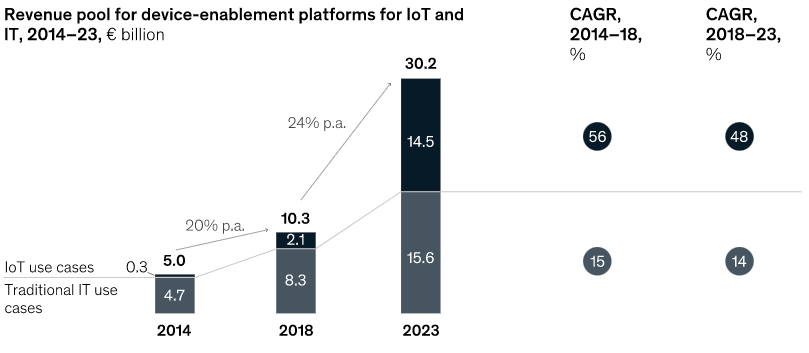
 
Figure 1: Revenue pool for device-enabled platforms, 2014-2023 (Dahlqvist et al., 2019)

Figure 1: Revenue pool for device-enabled platforms, 2014-2023 (Dahlqvist et al., 2019)


While this can be used as an indicator of the potential payout of investing in and developing a 5G/IoT strategy, doing so will require a realignment of shared values. A successful strategy for a startup or a company will take a multi-tiered approach taking into account the needs of businesses in a 5G / IoT powered world and deliver value accordingly.


Build on Strengths


Companies that garner the most economic benefit from IoT are those who played to their strengths and add connectivity to their existing products. Those developing new products and services for their customers from the ground-up find themselves in the bottom quintile of economic return.

The first strategy should be to lower the barriers to implementation for IoT. This can be achieved in two ways.

Firstly, develop frameworks for easy deployment and integrations of solutions. This value enables new businesses to be free to not pump costs into R&D but focus on what they do best and what gives them their competitive advantage.

Secondly, to help achieve this, add consulting to your suite of services through learning from your experiences and being able to react to needs and offer tailored solutions. By building highly skilled developers and consultants in your team, SMEs as well as larger firms can turn to you with their strategies and your consultants can stand to learn more about the landscape and effectively draw in new clients to a growing ecosystem. Co-evolution and collaboration are vital in industries where network externalities are crucial to corporate success and the more customers see peers join a network, the stronger the network effect gets.

Growing the ecosystem and learning from new firms will lead to a competitive advantage for you in your relevant industries. Additionally, vertically integrating the stack from Developers to business decision-makers allows you to create value in ways rivals cannot.


Deploy Multiple use cases


One or two deployments of IoT services statistically does not make a transformative impact on firms. In fact, it’s been studied that the greater the number of IoT use cases, the greater the correlation with financial success. This number is approximately 30 IoT projects deployed after which the effect starts to level off. It is the momentum in propelling these initiatives that leads to the widespread adoption and efficiency of IoT projects.

You can stand to learn from this and pour as much brainpower as you can into R&D projects for 5G and IoT powered devices. One of the biggest trends in organizational behaviour in the digital age is an appetite for risk creating a bias towards action. Top talent wants to work on these innovative projects and building a culture enabling this has side benefits to just a happier workforce.

Efficiencies manifest themselves as engineers are able to develop and use similar frameworks and solutions across projects. Learning from a variety of projects can also deepen domain knowledge, increasing the value that you can offer to customers and increasing the potential number of new customers you can attract. For all you know, you might find a niche as your team gravitates towards solving a certain set of problems.


Embrace Business-Process Changes


IoT is not a be-all, end-all solution to the current business problems being faced by firms. However, if employed correctly, IoT devices can improve decision making by generating previously unobtainable data. However, while the data can be generated easily, without insights the data is of no use to frontline employees needing to leverage the data for better decision making.

As such, along with building products that improve connectivity, look to extend a suite of services to cloud-based analytics and consulting services that can package the newly generated data into useful insights relevant to managers and other decision-makers. Managing these changes will be crucial for success and if you lend both a hand and an extra set of eyes to your customers, you make yourself invaluable.

But always keep the user in mind! IoT will flourish and will change the way many businesses operate. But if we can democratize it at this early stage and break down barriers in understanding the relevancy, we can increase adoption and bring in outside perspectives to unlock a whole new realm of possibilities.


Pay Attention to Market Opportunities


Building on the idea of learning while doing and identifying new possibilities, those looking to get into the device-enablement space have their pick of applications. Right now we’re in a stage where the most opportunities lie in improving business applications and the technology is relatively immature. This makes it an area that especially business users can maybe put their heads together to build.
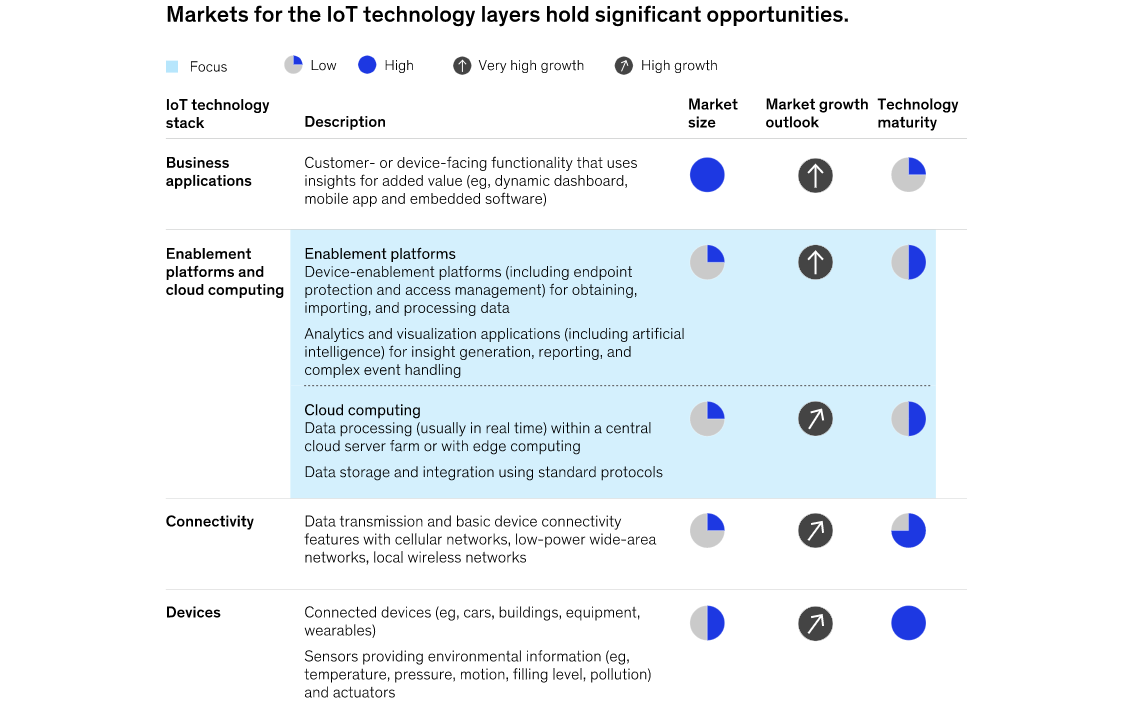


Understanding data has never been more important. With platforms like thingful allowing you access to millions of sensors around the world, building ways to understand, package and relay that data to help others to do what they do best will make you so incredibly valuable.

But don’t forget about device-enablement. The market is small right now but projected to grow exponentially for the future. Those who get on board now, learn as much as they can and help other companies do better stand to cement themselves as future leaders.


work with Startups


Why pour money into something that’s already being done? Employ a mindset of “work with those who know and do it better”. If you’re a large firm and have the resources to invest heavily in developing new solutions internally, make use of the fact that business centers around the world are hotspots for tech startups and innovation. Look around to your community and focus energy in combining heads and working with startups involved in IoT but also related technologies such as cloud computing, big data analytics, cloud gaming, edge computing and cyber-security. Being able to quickly learn, collaborate and co-create will advance the work we can do in IoT and most importantly uplift you and those who you work with.

The right partnerships can stand to bring large returns and with IoT Collaboratives popping up around the world in research institutions, I’d love to see this be embraced more and more. Because as we’ve seen in the case of incubators and accelerators, those who work together learn and do better.


Understand Blockchain


Lastly, you need to understand Blockchain If you plan to do anything with the data from IoT sensors, it’s crucial that it be accurate, traceable and transparent. It would benefit you or your team to get a handle on the technology as you build out your solutions. While there are many resources available to get to grips with Blockchain in IoT, briefly Blockchain allows for authentication, security and transparency along the major points in the IoT device lifecycle:

  • Blockchain allows for authentication in registering a device enabling trust in the data generated from day 1

  • Through distributed ledgers, transactions and readings are transparent and can be traced along different axes

  • Transmission of data between devices can be authenticated and securely processed

  • Through the distributed ledger, Blockchain can allow fast transfer and coordination of many billions of sensors

  • As the ledger is virtually un-hackable, you can be certain of the accuracy and traceability of the data


Where to go from here?


No doubt 5G and IoT are set to disrupt the landscape of business interaction. However, the way in which you respond to this disruption will determine your possibility for future success. Find ways of providing value through education, consulting and increasing the ease of implementation. If you’re lucky enough to have the resources to offer high-end solutions, still be cognizant of the ability of young, lean, niche and agile startups who are offering value in innovative ways to consumers. Finally, pay attention to the tech that binds this all together. AI, blockchain, edge-computing - all these are just tools to help people connect or make sense of data better. So use them, and make your idea a reality.

These are just some of my ideas, but leave a comment, get in touch or drop me a line if you want to chat more! I always have time to discuss the exciting opportunities of the future.

 
Photo by Swapnil Bapat on Unsplash

Creativity and learning from Cross-disciplinary Interaction /  by Usamah Khan

Photo by Kai Pilger on Unsplash

Photo by Kai Pilger on Unsplash

One of my favourite videos is Victor Wooten’s “The Language of Music and How to Speak It”. I used to watch it a lot when I was younger in my pursuit of becoming a better musician. While I highly recommend watching the whole video to get insight into creativity and inspiration, one line always stuck with me:

“if I want to be a better bassist, I need to listen to other bassists. If I want to be a better musician, I need to listen to all musicians”.

Victor Wooten is known for his signature tapping style - playing his bass like a piano. Something he learned from imagining how pianists would play the bass. At the crux of it, his point he was trying to make was that if you play the bass the way it’s ‘supposed’ to be played, you can make beautiful music. But if you gave the bass to a pianist or a golfer who had no idea how to play and just observed what they did and tried to recreate that, you’d be able to approach the instrument in a new more creative light.

I learnt a lot from this video but something I didn’t realize was how much I’d think back to it when trying to get better at other things in my life.

Due to being intensely curious by nature and my need to always learn new, and often random, skills in my life (that summer I learned the harmonica, the winter I took up knitting and my brief stint with calligraphy are examples of where my mind takes me) one thing that’s always stayed with me is how learning something new get’s easier the more you do it, and the more you draw from the lessons you learnt elsewhere, the more creative you become in your other skills.

Let’s look at this again with music. Often, like I mentioned, techniques are borrowed across musicians who employ methods that sound “normal” on one instrument, but “creative” on another. An example is legato, a technique where notes are smoothly connected from one to another, most often found among horn instrumentalists. This sounds commonplace on a horn, however, when employed on a guitar sounds different and creative. Alan Holdsworth who famously used this method on guitar as a way to mimic the horn is by many considered to be one of the most influential and creative guitarists of our time.

Similarly, Vangelis, the composer for “Blade Runner” and one of my favourite soundtracks of all time loved the vibrato sound, a sound really only attainable on string instruments, and built a mod for his synthesizer which influenced much of electronic music as we know it today.

I find this cross-disciplinary learning to be so powerful, especially now when I think about it in the context of a business environment.

In business, creativity manifests itself as something a little different than in music, but the idea is largely, are you thinking differently and able to use that thinking to build and maintain a personal and corporate competitive advantage. Creative individuals in the workforce, not to mention in society, are often highly valued and revered for an ability to look beyond the boundaries imposed on them. The most creative of these individuals often cement themselves as disruptors through their ability to develop innovative out of left field solutions to the known and unknown problems of society. Furthermore, while individual creativity is most often celebrated, collective creativity is just as important. More often than not, it is groups of creative individuals from different fields that produce impactful and creative work. Some argue that, it’s at the intersection of disciplines where most innovation takes place (Parjanen, 2012). That’s why I think it’s so important that leaders of any team understand the role that cross-disciplinary learning plays in creativity and hence should learn how to employ the best strategies to foster collaboration.

The concept of cross domain interaction is known as “Boundary Spanning” (Daley & Jeris, 2004). Boundary spanning has contributed to innovations in all fields, with the Center for Creative Leadership stating in 2014 that “today’s business landscapes requires leaders to bridge boundaries to tap the innovative outcomes that lie at the intersection of groups working together”. Notable examples in business are Elon Musk having said reading a diverse array of books from science-fiction to biographies helped shape what Tesla and SpaceX look like today (Economy, 2018). Another notably disruptive and creative field at the intersection of disciplines is biomimicry - learning from nature to develop better solutions for humans.

But how can leaders get individuals with different backgrounds to work together and subsequently work to achieve a creative goal? This is a two part problem, but one that with a little research we can try to answer.

How to get people across disciplines to collaborate?

Firstly, putting people from different backgrounds in a room can often hinder collaboration if the chemistry between individuals is not there. Participants in this freeform setting are more likely, in an effort to connect with each other (as we as humans want to do), find a common ground therefore limiting themselves to their small area of overlap where neither party is able to draw from their well of experience to explore a solution deeper (Ingram & Morris, 2007). Hence you need to understand the interplay between disciplines and how to manage it.

There a number of studies made to test methods and frameworks for cross-disciplinary collaboration. Joyce et al. suggest the “speedstorming” method (2010). This is an idea akin to that of “speed-dating” whereby placing participants in settings where interaction is limited to one-on-one and time is restricted can help teams understand who they gel with and hence who they can comfortably work with. This method is probably best suited to organizations with a large amount of talent to pull from and where this method would make it possible for the most amount of interactions to take place between employees.

Also, organizing people from different backgrounds requires leaders who have an understanding of the varied strengths and diversity in their team. Ernst and Chrobot-Mason, in their 2011 book, found that managers are rarely equipped with the tools to lead people of different backgrounds. They suggest managers need to first understand the key divisions in organizations - Demographic, Stakeholder, Geographic, Vertical and Horizontal. With this in mind, they can now develop three broad strategies for 1) managing boundaries, 2) forging common ground between team-members and 3) discovering new frontiers together. This can be achieved by leaders buffering the gap between individuals, reflecting on the differences, connecting individuals through collaboration, mobilizing them through creating common purpose and finally weaving the associated strengths of all parties in a web of interdependence to drive the team forward towards creative solutions.

How to achieve a creative goal?

Secondly, while creativity is a phenomenon that has a place in all disciplines, there are considerable differences in how disciplines approach and measure creativity. This is the basis of a study from Atilla Sik in 2015. Sik stated that in order to effectively manage creativity, the first step is to normalize a definition that is applicable to multiple disciplines. Sik references the “social view” or “perspective emphasis”  that states that creativity stems from three elements in a system (Csikszentmihalyi, 1997, 1999):

  1. A culture that contains symbolic rules

  2. A person who brings novelty into the symbolic domain

  3. A field of experts who recognize and validate the innovation.

Secondly, Sik brings out another tool which is acknowledging that creativity is a process. Depending on the school of thought, creative individuals generally follow the same path which are (in a business setting).

  1. Developing an interest

  2. Preparation and planning

  3. Incubation of the idea and ‘mulling it over’

  4. Finding the ‘eureka’ moment

  5. Evaluating the different solutions

  6. Implementing the final solution

If this ironically un-creative, yet important list is understand, it’s possible to begin to take an almost data-driven approach to quantifying creativity and motivation. From this we can hence understand when and where interventions are needed to further this creativity. Furthermore, understanding that following this flow, and placing it within the context of the system in question (the list above) teams can start to build a formula for creativity.

What should we start with?

I would be remiss if I wrote this but didn’t offer my view on where to start. In my opinion, when building a team it comes down to bringing on not just the best people for the job, but those who also have deep or niche interests. Ask your candidates what they do in their own time when no one is telling them what to do. Then ask them to expand, and let them “nerd-out” with you, if only for just a bit. Because chances are, they’re passionate about something. And if you can relate that to what you’re doing, and they can find something to latch on to in your team’s goals, they will take from their experiences and go down the rabbit hole with you and learn how they learn best. And maybe, you might just learn a thing or two to uplift your own-self.

Lastly, if you can understand this for yourself, then try to always find the connection between what you love doing and what you’re working on. I grew up skateboarding, and a lot of the lessons like slamming and getting back up again sit with me at my core. But as a developer, there was something else I was doing when writing code that I didn’t realize until I watched this video from Rodney Mullen, the godfather of skateboarding. He brought together hackers and skaters in the same room, and told them how, essentially, they work the same way. Sometimes when you’re trying to learn a new trick/coding a function, you overshoot, with ‘errors’. Other times, you undershoot. But what both skaters and developers do is understand that now, we’ve found our brackets. It’s now just a matter of closing them in tighter and tighter until it all works out and you roll away/run with no errors.

So learn from what you love, let that influence what you do, and surround yourself with others who like things different to you. Hopefully, you’ll be a better, more creative person for it.

References

Follow this link to references for this post

The Sharing Economy /  by Usamah Khan

Photo by Austin Distel on Unsplash

Over the last few years we’ve seen a change in how we interact with different goods and services. Namely, we’re moving away from ownership towards a culture of ‘borrowing’ someone’s time, space or assets for specific needs. This new marketplace is commonly referred to as “The sharing economy” and, academically speaking, is a place for individuals with ownership of assets to share and rent out their excess supply to others in need. It’s currently a thriving marketplace with key players such as WeWork, Airbnb and Uber, valued at billions of dollars. However, as we enter the next stage of the lifecycle of the sharing economy where we can see big players being challenged by new entries, it seems time to re-examine traditional frameworks and be more inquisitive as to the future.

If I were to wager a guess, over the next three years players in this space should look towards adapting tech such as blockchain and AI, to further facilitate the temporary transfer of ownership as well as work closely with governing entities in drafting policies and regulations for the future. But that’s easy to just say, so this is a study of the what, why and how the future looks from my eyes.

Introducing the Sharing Economy

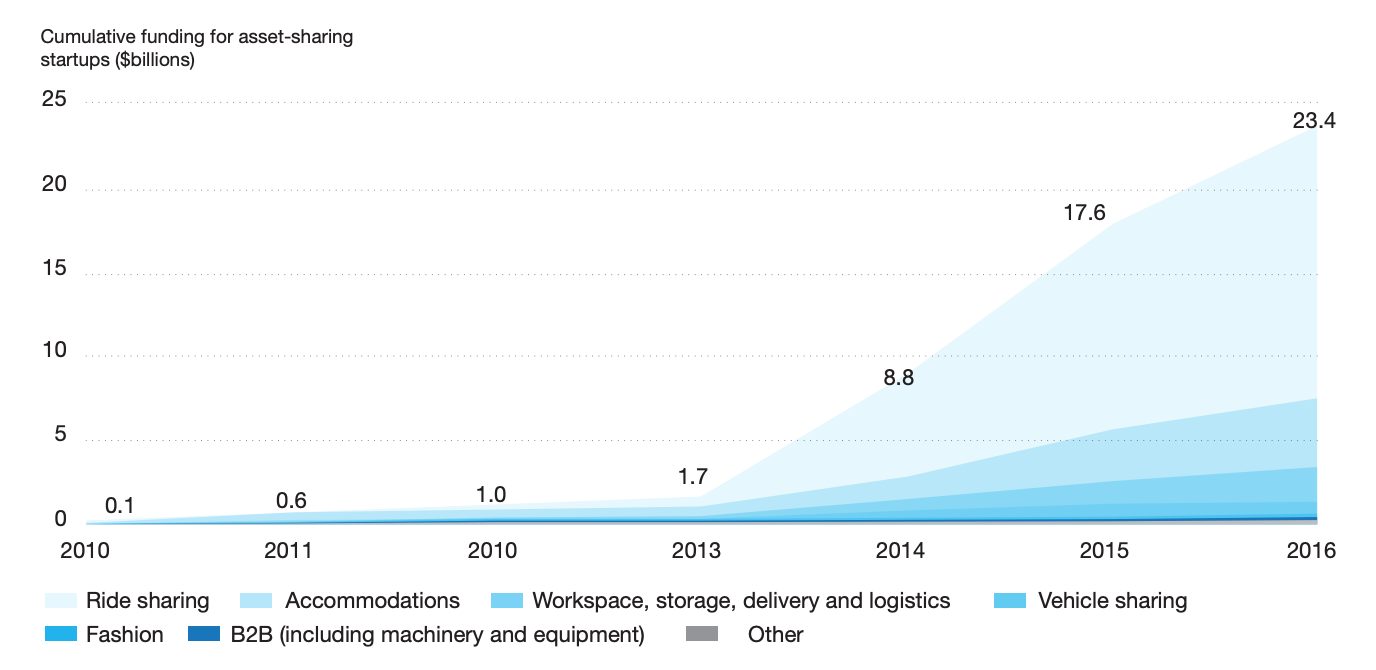
Sharing is one of the oldest concepts in civilization. For years, we’ve bartered, pooled resources, exchanged goods and lent time for services. However, it’s always occurred on a needs basis between individuals and has rarely been facilitated by platforms or groups. With the advent of digital technologies and connectedness, the concept of sharing has not changed, yet the methods by which people can connect with others to rent out their excess supply has drastically improved. This has given rise to this new marketplace for consumers and producers. Ever year more money is being put into “asset-sharing” startups, indicating a growth that seems unlikely to slow down.

Cumulative funding of Asset-Sharing Startups since 2010 (Wallenstein & Shellat, 2017)

Cumulative funding of Asset-Sharing Startups since 2010 (Wallenstein & Shellat, 2017)

The rise of the sharing economy presents a wealth of possibilities, but it is also not without its problems. The aim of this post is to act as a guide to the future by providing, from a marketers perspective, an overview of the sharing economy, its effects on the actors and processes in traditional marketing, and finally what can marketing scholars and practitioners look towards in the future.

What is the sharing economy?

Because of the complexity of the players and driving forces involved, there are many definitions for the sharing economy, and none universally agreed upon. We loosely defined it earlier, but diving a little deeper, at its heart, the sharing economy enables individuals to offer the excess capacity of their assets to others who have a need or desire for it and capitalize on it. Eckhardt et al. (2019) provide an expanded definition that touches on crucial aspects that can be explored to further our understanding. They state that the sharing economy is:

“…a scalable socioeconomic system that employs technology-enabled platforms to provide users with temporary access to tangible and intangible resources that may be crowdsourced”.

There are three key themes to familiarize yourself with as you explore the sharing economy further.

Scalable Socioeconomic System

An economy encapsulates the management and allocation of scarce resources in a community. In a sharing economy, this community is defined by the providers and consumers of an offering. As more people start to recognize the excess supply in their assets and are given the opportunity for a quid-pro-quo economic exchange by sharing, that community grows. In fact, the role of the consumer is also expanded whereby they take on both the demand and supply side of interactions.

Consider Airbnb. A host may offer their extra room one day but then take a holiday in another home the next week. This gives rise to their enhanced role where the producer and consumer become one. A role that we can refer to as the “prosumer”.

Technology-enabled platforms

Not much to say in words other than the biggest enabler of the sharing economy has been the technological platforms that power them. Without them, there’d arguably be no sharing economy. The platforms have two crucial offerings -

  1. A dynamic matching algorithm to identify idle supply and connect with demand, and

  2. A trust verification system whereby users can quickly gain trust through access to peer reviews and a reputation system

By allowing this, the technology allows for matching and effective scaling of sharing solutions.

Crowdsourced resources

Lastly, we come to the resources that this market is built on. Simply put, assets are shared when the owner has no need for them in the moment. By recognizing the potential of this phenomenon, startups such as Uber and Airbnb took to leveraging the resources of others and not producing themselves. This displays one of the first major shifts from the traditional economy where the firm was in charge of creating offerings and subsequently marketing them. Now platforms do not engage in production but utilize the resources of others.

Through defining the key concepts of the emerging sharing economy, we can begin to see a drift from the traditional economy. Armed with this understanding we can start to examine the implications of the sharing economy on the different actors and processes in businesses and marketing and recommend questions to ask, and research to pursue for the future.

Who are the actors?

In a marketplace there are three traditional actors: consumers, firms and regulatory entities. With the rise of the sharing economy, it’d be wise to note the changes in the roles as they develop new frameworks.

Consumers

The biggest change we see in the role of the consumer is their enhanced role due to their capacity to offer temporary access to their assets and monetize their excess capacity, while also taking part in the consumption of the excess supply of others. Additionally, due to rating systems, consumers are typically placed in mediating roles that traditional firms would normally be in charge of. Thus, the consumer is in a position of power and possesses the ability to have an effect on the experience of other consumers, in some way decentralizing the firm’s traditional function to market a product and ensure customer satisfaction.

It seems that for now, the resources that provide the best value to consumers are those with modularity, i.e. resources that can be sourced from dispersed providers and integrated into a single platform. An area to pay close attention to is the development of new mappings of resources from providers to consumers.

Firms

Firms typically create products and market them to consumers. However, in the sharing economy firms merely leverage the supply of others and match them with those seeking to rent. The firm then levies fees for the use of the platform. While this is a benefit to the firm, ultimately it seems like it’s coming at a cost to the consumer. We can see this as platforms such as Lyft, Airbnb, and WeWork are being priced higher and higher, without a clear improvement in services and offerings to the end user. This hurts in their ability to retain good quality providers.

Additionally, firms are no longer in the business of offering new and innovative products but are merely facilitating the transfer of temporary ownership. The role of innovation has changed from disruptive to incremental. Marketers should look at the role innovation now plays for new players setting up platforms.

humphrey-muleba-R8P8iZ9nRko-unsplash.jpg

Regulatory Entities

Finally, regulatory entities relate to the laws and policies to govern and influence the actions of those taking part in the sharing economy. The sharing economy poses challenges to existing legal frameworks (Anderson and Huffman, 2017), yet regulatory entities also pose challenges to the sharing economy. While some say the sharing economy should be regulated and others say no, what is evident is a disconnect between the goals of either side of the equation. The biggest conflict comes between governments fighting back at the unregulated sharing economy viewing it as a detriment to social welfare, yet entrepreneurs claim their platforms exist to improving social welfare. It’ll be crucial to examine this disconnect when working with governing bodies to do the best to close this gap.

What does the future look like?

The next three years seem like they will be important in the gauging the direction that the sharing economy will take. Many initial players who have enjoyed years competition free, are starting to stagger under their own weight. The current effect of coronavirus aside, 2020 may be the year we see the first bankruptcies. In this case, what can we learn from the mistakes of these big players? It seems in the near future, marketers should keep a close eye on new technologies and their interactions with regulatory entities.

New Technologies

Technology has been the driver in the emergence of the sharing economy, and it would be wise to assume that this trend will only continue. As noted by Wallenstein and Shelat (2017), “the technological possibilities ... are still maturing”. As with all speculation on technology, it’s important to understand the role it plays as a tool to achieve a goal. We should be careful in jumping to the conclusion that more technology is the answer and that the sharing economy will be dominated by the those who code the best algorithms. Rather, emerging technology will help facilitate human needs and desires. So with this, by understanding the roles of the consumer, the firm and governing bodies, the future will be in identifying the technologies and subsidiary strategies that will aid in reducing friction between the different actors.

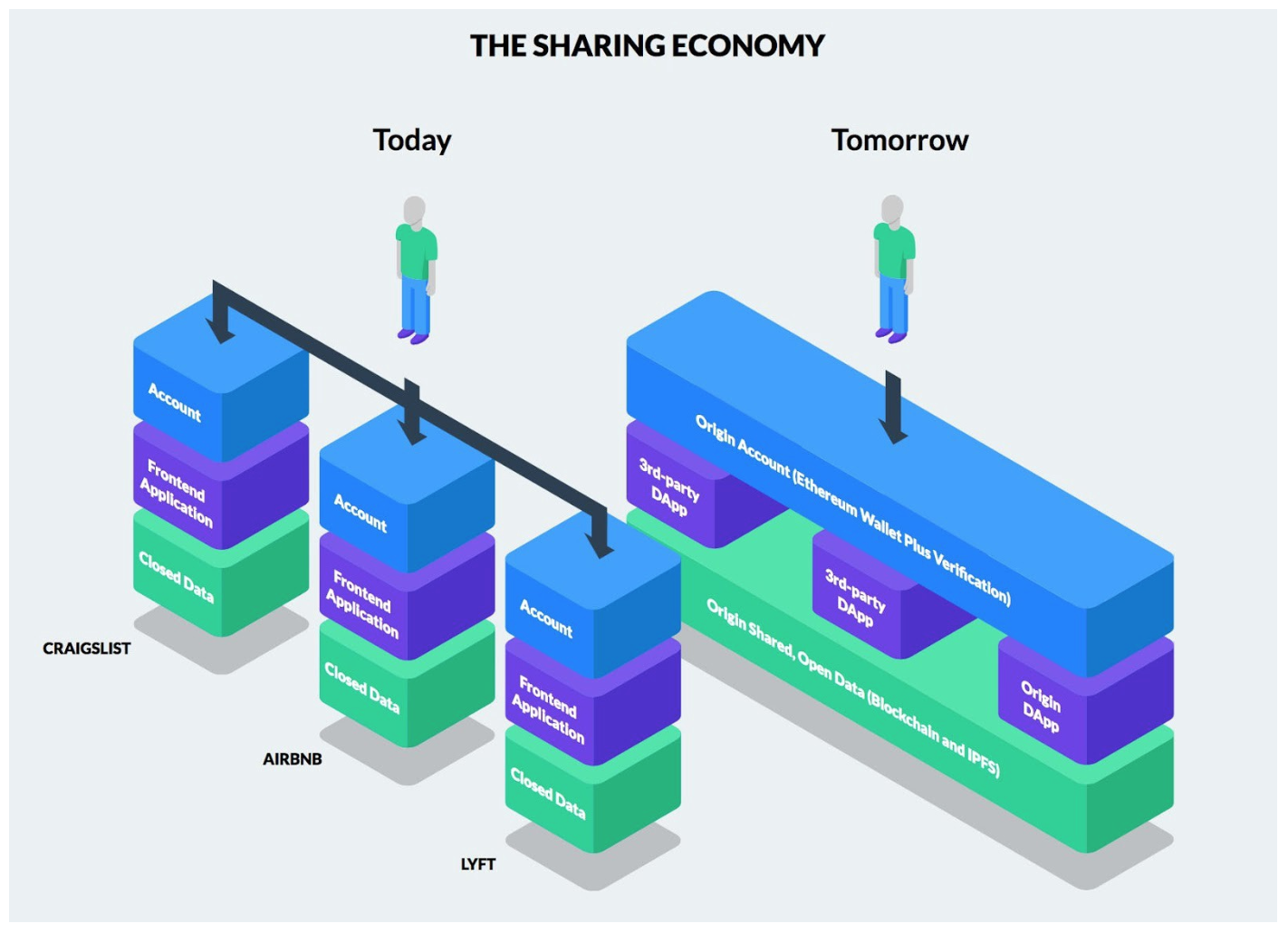
As we’ve noted, platforms are benefiting from levying fees from the users – who are in this case both the suppliers and consumers. As history shows in any economy, startups with disruptive business models will always cement a firm footing. But in looking at the landscape of the sharing economy we should look beyond just business models but at technologies that aim to increase the power of users. Most notably, looking at blockchain. Blockchain essentially provides framework to cut out the middleman, and provide transparency and enable easy peer-to-peer interactions without the 20-30% transaction fees firms typically apply (Thellman, 2018). In fact, we’re seeing an emergence in startups building frameworks for others to build their sharing platforms on top of.

Infographic sharing what a decentralized sharing economy looks like (Source Origin Protocol https://www.originprotocol.com/en)

Infographic sharing what a decentralized sharing economy looks like (Source Origin Protocol https://www.originprotocol.com/en)

As we’ve seen in the case of Shopify and Squarespace, platforms that democratize their expertise and empower others to start their own businesses do very well and command a lot of power in the economy. As this is a recent trend, this field should be watched closely in the near future as first mover advantage has proven time and time again to be extremely powerful.

Additionally, as we’re seeing across markets, new and better AI seems to be a challenger of current platforms. For example, we’ve made it clear that the sharing economy is about access to excess supply, but we may need to look even deeper. In the case of Uber and Lyft, the excess supply is governed two-fold; by excess supply of the car but also the time allowance of the driver. Tesla are moving into the sharing economy by building their “Tesla network”, taking advantage of excess supply of cars without compromising the time of the driver by using the autonomous nature of the car to pick up and drop those looking for rides (Korosec, 2019). In this case, consumers are indirectly influenced in their purchasing decisions by AI, as they start to look at their new cars as assets and investments.

Again, the point is not to look to blockchain and AI as the future of the sharing economy but provide an example to the point that we should keep a close eye on what emerging technologies are doing to disrupt the playing field. In the case of blockchain, what is happening to give more power to users. Harvard Professor Samer Hassan, in his research claims blockchain can help sharing economy projects to overcome several challenges they face at infrastructure, governance and economic levels” (2018). For AI, we can look at asking questions along the lines of what opportunities are there to connect not just those with ownership of the resource to those seeking access, but also extend a more complex equation, to those with excess time, without the resources and provide a match to resources they can rent to further rent to others for their gain.

Working with Regulatory Entities

Working with governments and regulatory entities will be crucial. Government intervention, both supportive and regulative, will be critical in the near future when building up of the sharing economy. While we’ve noted that sharing is not a new concept, the extent to which it is scaling and its effect on workers has governments worried.

What we have seen so far with the sharing economy – and to an extent, technology – is that it has advanced beyond understanding and grasp of current decision makers. As governments worldwide deal with the state of their troubling economies, externalities from the sharing economy are seen not as a byproduct of poor economic growth and stability, but are seen as a cause. Regularly the terms “gig economy” and “sharing economy” are used synonymously when they are different concepts with a certain amount of overlap. As such, it’ll be important to develop and provide frameworks, understandings, and rationales to policy makers so they have a better understanding of the market. Furthermore, they can work to incorporate as opposed to challenge the platforms. The World Economic Forum in 2017 provided research helping international agencies and entities understand the differences between “similar emerging concepts” and the sharing economy especially in how these concepts manifest themselves in urban communities. In the next three years as key players in the world economies are hosting national elections with potential for big changes in leadership, it may be wise for marketers to start incorporating government organizations in their strategies and sharing their knowledge to keep them better informed as they move towards new policies.

Implications of Coronavirus and the societal changes

When I was initially putting together this study, it was a time when a novel respiratory flu-like disease was not affecting every industry on the planet. It seems likely that the world will bounce back from Covid-19, but with some dire economic consequences for firms of all sizes. While I think some of my initial thoughts are still relevant to the future of the sharing economy, I can’t help but wonder about the societal and cultural effect months of social distancing will have on our concept of “sharing” with others. Will we exit this to a future where we have no qualms about working side-by-side with strangers at a WeWork? Or sit next to someone you’re picking up in your car to earn a little on the side? Would there be some trepidation on our part in borrowing items handled by others with no record of who? I would be remiss if I didn’t consider these issues in a study.

My view is that the sharing of ones excess supply will continue to be a way for us to share the benefit and the value of our assets. With an added incentive of being able to monetize this shared value, it’ll only continue to be more and more important to us as we enter what seems like another economic downturn. That being said, it’ll be increasingly important for individuals and platform enablers to be able to verify the usage and ensure the security of users. Blockchain at its heart aims to provide better, more secure peer-2-peer interaction. Firms like Origin Protocol who were early movers in this field might just see their value proposition become more attractive as the months go on.

On the flip side however, we may have to accept a ‘de-volution’ back to ownership of assets. But as affordability becomes less, will we see a shift towards modular solutions? And as we’ve seen with gig workers unable to access health insurance or benefits, will we start giving more power to those who own and share their assets eliminating the ‘gig’ aspect of the equation? I don’t know what this future looks like. But with it may come the change that labour economists have been looking for and maybe that’s a good thing. The demise of the gig economy and the rise of a more secure sharing economy with power in the hands of the prosumers. Wouldn’t that be something.

Final Thoughts

The sharing economy is here to stay, not as a separate entity but in many ways now part of the economy. The ones who stand to make the most impact and be helpful in guiding the future will embrace new technologies that reduce friction between players and continue to use new data to challenge industries and see what new resources can be shared. Time and time again, we are seeing first mover advantage play the most important role in cementing a footing in the industry and in my opinion the next 3 to 5 years will be crucial in laying the path for the future. Identifying the underlying principles guiding the sharing economy, working with regulatory agencies and deploying disruptive strategies incorporating new technologies will be the steps to take.