
Photo by Austin Distel on Unsplash
Over the last few years we’ve seen a change in how we interact with different goods and services. Namely, we’re moving away from ownership towards a culture of ‘borrowing’ someone’s time, space or assets for specific needs. This new marketplace is commonly referred to as “The sharing economy” and, academically speaking, is a place for individuals with ownership of assets to share and rent out their excess supply to others in need. It’s currently a thriving marketplace with key players such as WeWork, Airbnb and Uber, valued at billions of dollars. However, as we enter the next stage of the lifecycle of the sharing economy where we can see big players being challenged by new entries, it seems time to re-examine traditional frameworks and be more inquisitive as to the future.
If I were to wager a guess, over the next three years players in this space should look towards adapting tech such as blockchain and AI, to further facilitate the temporary transfer of ownership as well as work closely with governing entities in drafting policies and regulations for the future. But that’s easy to just say, so this is a study of the what, why and how the future looks from my eyes.
Introducing the Sharing Economy
Sharing is one of the oldest concepts in civilization. For years, we’ve bartered, pooled resources, exchanged goods and lent time for services. However, it’s always occurred on a needs basis between individuals and has rarely been facilitated by platforms or groups. With the advent of digital technologies and connectedness, the concept of sharing has not changed, yet the methods by which people can connect with others to rent out their excess supply has drastically improved. This has given rise to this new marketplace for consumers and producers. Ever year more money is being put into “asset-sharing” startups, indicating a growth that seems unlikely to slow down.
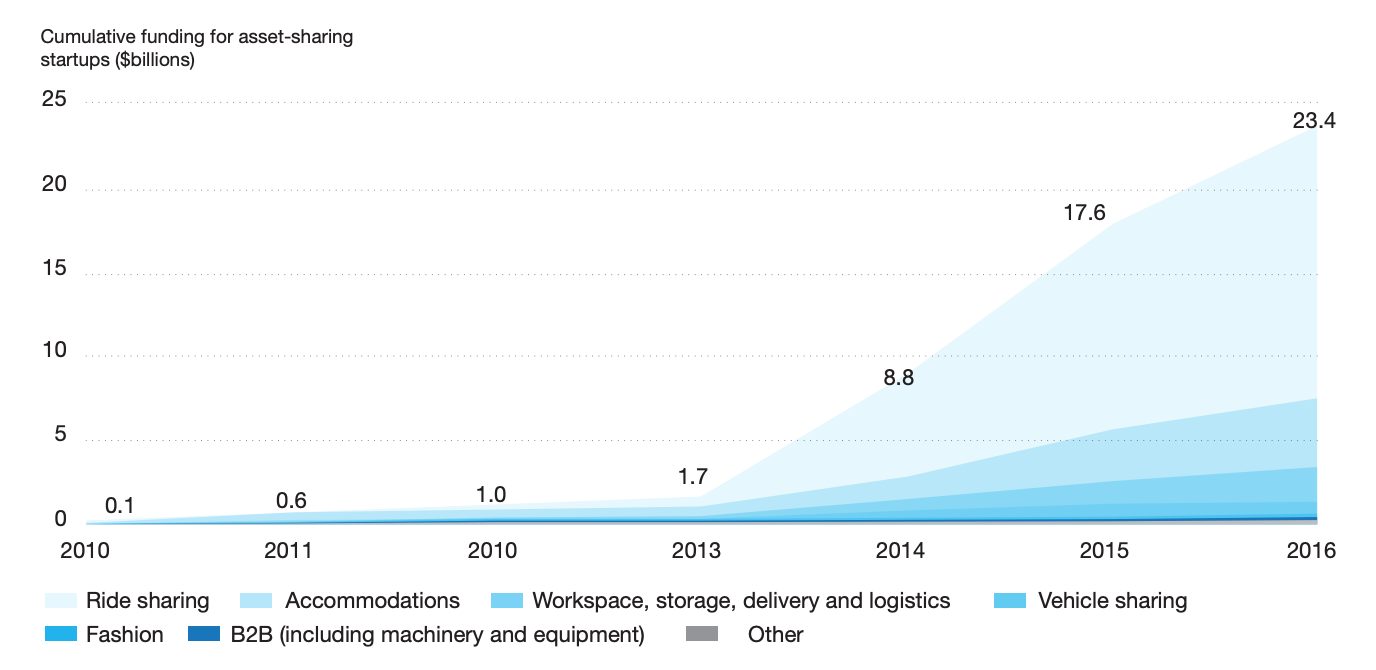
Cumulative funding of Asset-Sharing Startups since 2010 (Wallenstein & Shellat, 2017)
The rise of the sharing economy presents a wealth of possibilities, but it is also not without its problems. The aim of this post is to act as a guide to the future by providing, from a marketers perspective, an overview of the sharing economy, its effects on the actors and processes in traditional marketing, and finally what can marketing scholars and practitioners look towards in the future.
What is the sharing economy?
Because of the complexity of the players and driving forces involved, there are many definitions for the sharing economy, and none universally agreed upon. We loosely defined it earlier, but diving a little deeper, at its heart, the sharing economy enables individuals to offer the excess capacity of their assets to others who have a need or desire for it and capitalize on it. Eckhardt et al. (2019) provide an expanded definition that touches on crucial aspects that can be explored to further our understanding. They state that the sharing economy is:
“…a scalable socioeconomic system that employs technology-enabled platforms to provide users with temporary access to tangible and intangible resources that may be crowdsourced”.
There are three key themes to familiarize yourself with as you explore the sharing economy further.
Scalable Socioeconomic System
An economy encapsulates the management and allocation of scarce resources in a community. In a sharing economy, this community is defined by the providers and consumers of an offering. As more people start to recognize the excess supply in their assets and are given the opportunity for a quid-pro-quo economic exchange by sharing, that community grows. In fact, the role of the consumer is also expanded whereby they take on both the demand and supply side of interactions.
Consider Airbnb. A host may offer their extra room one day but then take a holiday in another home the next week. This gives rise to their enhanced role where the producer and consumer become one. A role that we can refer to as the “prosumer”.
Technology-enabled platforms
Not much to say in words other than the biggest enabler of the sharing economy has been the technological platforms that power them. Without them, there’d arguably be no sharing economy. The platforms have two crucial offerings -
A dynamic matching algorithm to identify idle supply and connect with demand, and
A trust verification system whereby users can quickly gain trust through access to peer reviews and a reputation system
By allowing this, the technology allows for matching and effective scaling of sharing solutions.
Crowdsourced resources
Lastly, we come to the resources that this market is built on. Simply put, assets are shared when the owner has no need for them in the moment. By recognizing the potential of this phenomenon, startups such as Uber and Airbnb took to leveraging the resources of others and not producing themselves. This displays one of the first major shifts from the traditional economy where the firm was in charge of creating offerings and subsequently marketing them. Now platforms do not engage in production but utilize the resources of others.
Through defining the key concepts of the emerging sharing economy, we can begin to see a drift from the traditional economy. Armed with this understanding we can start to examine the implications of the sharing economy on the different actors and processes in businesses and marketing and recommend questions to ask, and research to pursue for the future.
Who are the actors?
In a marketplace there are three traditional actors: consumers, firms and regulatory entities. With the rise of the sharing economy, it’d be wise to note the changes in the roles as they develop new frameworks.
Consumers
The biggest change we see in the role of the consumer is their enhanced role due to their capacity to offer temporary access to their assets and monetize their excess capacity, while also taking part in the consumption of the excess supply of others. Additionally, due to rating systems, consumers are typically placed in mediating roles that traditional firms would normally be in charge of. Thus, the consumer is in a position of power and possesses the ability to have an effect on the experience of other consumers, in some way decentralizing the firm’s traditional function to market a product and ensure customer satisfaction.
It seems that for now, the resources that provide the best value to consumers are those with modularity, i.e. resources that can be sourced from dispersed providers and integrated into a single platform. An area to pay close attention to is the development of new mappings of resources from providers to consumers.
Firms
Firms typically create products and market them to consumers. However, in the sharing economy firms merely leverage the supply of others and match them with those seeking to rent. The firm then levies fees for the use of the platform. While this is a benefit to the firm, ultimately it seems like it’s coming at a cost to the consumer. We can see this as platforms such as Lyft, Airbnb, and WeWork are being priced higher and higher, without a clear improvement in services and offerings to the end user. This hurts in their ability to retain good quality providers.
Additionally, firms are no longer in the business of offering new and innovative products but are merely facilitating the transfer of temporary ownership. The role of innovation has changed from disruptive to incremental. Marketers should look at the role innovation now plays for new players setting up platforms.

Regulatory Entities
Finally, regulatory entities relate to the laws and policies to govern and influence the actions of those taking part in the sharing economy. The sharing economy poses challenges to existing legal frameworks (Anderson and Huffman, 2017), yet regulatory entities also pose challenges to the sharing economy. While some say the sharing economy should be regulated and others say no, what is evident is a disconnect between the goals of either side of the equation. The biggest conflict comes between governments fighting back at the unregulated sharing economy viewing it as a detriment to social welfare, yet entrepreneurs claim their platforms exist to improving social welfare. It’ll be crucial to examine this disconnect when working with governing bodies to do the best to close this gap.
What does the future look like?
The next three years seem like they will be important in the gauging the direction that the sharing economy will take. Many initial players who have enjoyed years competition free, are starting to stagger under their own weight. The current effect of coronavirus aside, 2020 may be the year we see the first bankruptcies. In this case, what can we learn from the mistakes of these big players? It seems in the near future, marketers should keep a close eye on new technologies and their interactions with regulatory entities.
New Technologies
Technology has been the driver in the emergence of the sharing economy, and it would be wise to assume that this trend will only continue. As noted by Wallenstein and Shelat (2017), “the technological possibilities ... are still maturing”. As with all speculation on technology, it’s important to understand the role it plays as a tool to achieve a goal. We should be careful in jumping to the conclusion that more technology is the answer and that the sharing economy will be dominated by the those who code the best algorithms. Rather, emerging technology will help facilitate human needs and desires. So with this, by understanding the roles of the consumer, the firm and governing bodies, the future will be in identifying the technologies and subsidiary strategies that will aid in reducing friction between the different actors.
As we’ve noted, platforms are benefiting from levying fees from the users – who are in this case both the suppliers and consumers. As history shows in any economy, startups with disruptive business models will always cement a firm footing. But in looking at the landscape of the sharing economy we should look beyond just business models but at technologies that aim to increase the power of users. Most notably, looking at blockchain. Blockchain essentially provides framework to cut out the middleman, and provide transparency and enable easy peer-to-peer interactions without the 20-30% transaction fees firms typically apply (Thellman, 2018). In fact, we’re seeing an emergence in startups building frameworks for others to build their sharing platforms on top of.
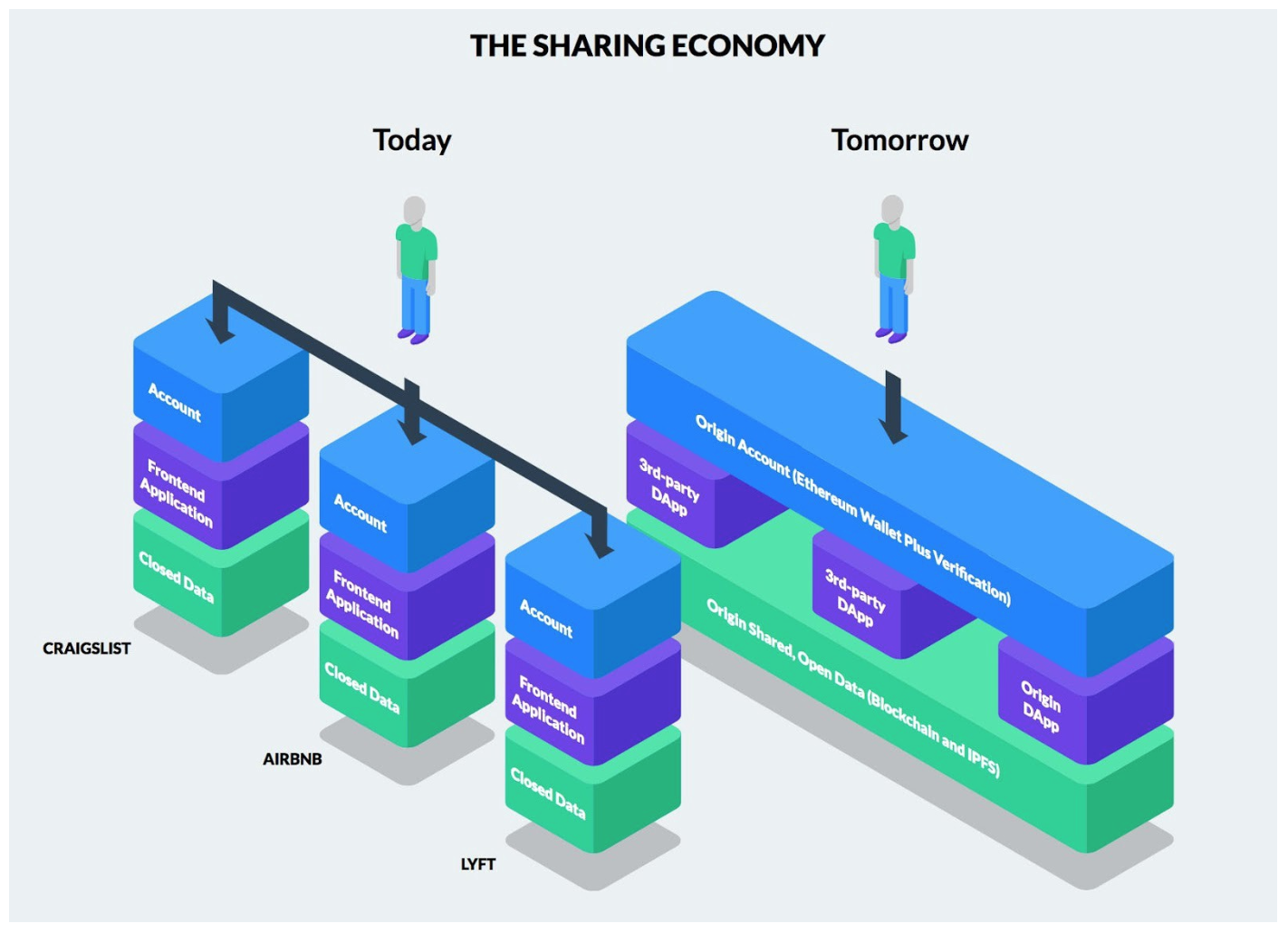
Infographic sharing what a decentralized sharing economy looks like (Source Origin Protocol https://www.originprotocol.com/en)
As we’ve seen in the case of Shopify and Squarespace, platforms that democratize their expertise and empower others to start their own businesses do very well and command a lot of power in the economy. As this is a recent trend, this field should be watched closely in the near future as first mover advantage has proven time and time again to be extremely powerful.
Additionally, as we’re seeing across markets, new and better AI seems to be a challenger of current platforms. For example, we’ve made it clear that the sharing economy is about access to excess supply, but we may need to look even deeper. In the case of Uber and Lyft, the excess supply is governed two-fold; by excess supply of the car but also the time allowance of the driver. Tesla are moving into the sharing economy by building their “Tesla network”, taking advantage of excess supply of cars without compromising the time of the driver by using the autonomous nature of the car to pick up and drop those looking for rides (Korosec, 2019). In this case, consumers are indirectly influenced in their purchasing decisions by AI, as they start to look at their new cars as assets and investments.
Again, the point is not to look to blockchain and AI as the future of the sharing economy but provide an example to the point that we should keep a close eye on what emerging technologies are doing to disrupt the playing field. In the case of blockchain, what is happening to give more power to users. Harvard Professor Samer Hassan, in his research claims blockchain can help sharing economy projects to overcome several challenges they face at infrastructure, governance and economic levels” (2018). For AI, we can look at asking questions along the lines of what opportunities are there to connect not just those with ownership of the resource to those seeking access, but also extend a more complex equation, to those with excess time, without the resources and provide a match to resources they can rent to further rent to others for their gain.
Working with Regulatory Entities
Working with governments and regulatory entities will be crucial. Government intervention, both supportive and regulative, will be critical in the near future when building up of the sharing economy. While we’ve noted that sharing is not a new concept, the extent to which it is scaling and its effect on workers has governments worried.
What we have seen so far with the sharing economy – and to an extent, technology – is that it has advanced beyond understanding and grasp of current decision makers. As governments worldwide deal with the state of their troubling economies, externalities from the sharing economy are seen not as a byproduct of poor economic growth and stability, but are seen as a cause. Regularly the terms “gig economy” and “sharing economy” are used synonymously when they are different concepts with a certain amount of overlap. As such, it’ll be important to develop and provide frameworks, understandings, and rationales to policy makers so they have a better understanding of the market. Furthermore, they can work to incorporate as opposed to challenge the platforms. The World Economic Forum in 2017 provided research helping international agencies and entities understand the differences between “similar emerging concepts” and the sharing economy especially in how these concepts manifest themselves in urban communities. In the next three years as key players in the world economies are hosting national elections with potential for big changes in leadership, it may be wise for marketers to start incorporating government organizations in their strategies and sharing their knowledge to keep them better informed as they move towards new policies.
Implications of Coronavirus and the societal changes
When I was initially putting together this study, it was a time when a novel respiratory flu-like disease was not affecting every industry on the planet. It seems likely that the world will bounce back from Covid-19, but with some dire economic consequences for firms of all sizes. While I think some of my initial thoughts are still relevant to the future of the sharing economy, I can’t help but wonder about the societal and cultural effect months of social distancing will have on our concept of “sharing” with others. Will we exit this to a future where we have no qualms about working side-by-side with strangers at a WeWork? Or sit next to someone you’re picking up in your car to earn a little on the side? Would there be some trepidation on our part in borrowing items handled by others with no record of who? I would be remiss if I didn’t consider these issues in a study.
My view is that the sharing of ones excess supply will continue to be a way for us to share the benefit and the value of our assets. With an added incentive of being able to monetize this shared value, it’ll only continue to be more and more important to us as we enter what seems like another economic downturn. That being said, it’ll be increasingly important for individuals and platform enablers to be able to verify the usage and ensure the security of users. Blockchain at its heart aims to provide better, more secure peer-2-peer interaction. Firms like Origin Protocol who were early movers in this field might just see their value proposition become more attractive as the months go on.
On the flip side however, we may have to accept a ‘de-volution’ back to ownership of assets. But as affordability becomes less, will we see a shift towards modular solutions? And as we’ve seen with gig workers unable to access health insurance or benefits, will we start giving more power to those who own and share their assets eliminating the ‘gig’ aspect of the equation? I don’t know what this future looks like. But with it may come the change that labour economists have been looking for and maybe that’s a good thing. The demise of the gig economy and the rise of a more secure sharing economy with power in the hands of the prosumers. Wouldn’t that be something.
Final Thoughts
The sharing economy is here to stay, not as a separate entity but in many ways now part of the economy. The ones who stand to make the most impact and be helpful in guiding the future will embrace new technologies that reduce friction between players and continue to use new data to challenge industries and see what new resources can be shared. Time and time again, we are seeing first mover advantage play the most important role in cementing a footing in the industry and in my opinion the next 3 to 5 years will be crucial in laying the path for the future. Identifying the underlying principles guiding the sharing economy, working with regulatory agencies and deploying disruptive strategies incorporating new technologies will be the steps to take.