
Photo by BENCE BOROS on Unsplash
When I think about the future, I get most excited about the potential of the Internet of Things (IoT). It represents a step forward for connectivity and brings with it a whole host of new and exciting possibilities. With billions of devices around the world connected and sharing data, from fridges to air quality sensors, the world around us is becoming smarter, responding to our needs in intelligent and deliberate ways. Working in the IoT space for over 3 years now, I’ve developed a pretty good feel for how to access and make sense of open-source IoT data, and what kind of products can be built harnessing the data. However, recently I’ve been curious and drawn towards what opportunities are out there and overarching strategies companies need to take to jump on the IoT revolution. With 5G just around the corner, enabling faster connectivity and possibilities for IoT, I think no matter what the industry, it will be more and more crucial to have an understanding of the underlying technologies and the opportunities associated with it.
So with that, I collected my thoughts and wrote this with the aim to understand and explain the market opportunities within IoT and the end value it can bring to firms. Furthermore, I’ve pieced together my own ideas on what I think are some strategies to take if you’re thinking of starting an IoT company or for organizations looking towards a connected future.
A CONNECTED FUTURE
IoT has cemented its place in the world but 5G is the next frontier. Boasting faster speeds and lower latency, 5G stands to change the landscape for consumers but more importantly, industries such as healthcare, manufacturing, insurance and banking. With IoT devices connected on 5G networks, data can move from distant servers to ‘edge devices’ and sensors will be able to process and share data faster leading to more up to date business decision making. However, this advancement will also introduce uncertainty along many dimensions. Companies and ideas that develop and invest in a future strategy aligning these disruptive technologies and mitigating the uncertainty will see this as their key competitive advantage.
In shaping what a vision for the future looks like, it’ll be imperative that your strategy advances connection between people, builds on your competitive strengths and embraces new opportunities for an integrated digital future. With the plethora of opportunities available there’s room at this early stage to cement yourself as an industry ‘go-to’ when it comes to developing and offering IoT infrastructures and frameworks.
If you’re doing anything to advance an IoT agenda, understand what makes a successful IoT strategy and build on that or help others achieve that. Based on a 2018 study of 300 IoT executives and what I’ve learned over the last few years, a winning 5G/IoT strategy should comprise the following aspects:
Understanding the need for Device-enablement platforms
Building on a firm’s strengths when implementing IoT
Deploying multiple use cases internally and externally to climb the IoT learning curve
Embracing opportunities for business-process changes
Co-creating with startups that fill a gap in value
Paying attention to market opportunities and where IoT is needed the most
Leveraging Blockchain for secure and transparent data
Device-Enablement Platforms
In 2019, a McKinsey review of the growing opportunities in IoT indicated the importance and growth of ‘device-enablement’ platforms. Device-enablement platforms collect and link data from disparate IoT devices and process them through cloud services allowing us to generate insights from large amounts of data.
The simplest way to describe the opportunities in the market for device enablement platforms is by focusing on lowering the barriers to implementation for SMEs who have few resources to develop IoT solutions on their own. Doing so has the potential to attract new clients and the uptake of businesses requiring these services will result in a revenue pool estimated to grow at an average CAGR 24% (48% for IoT specific use cases) between 2018 - 2023.
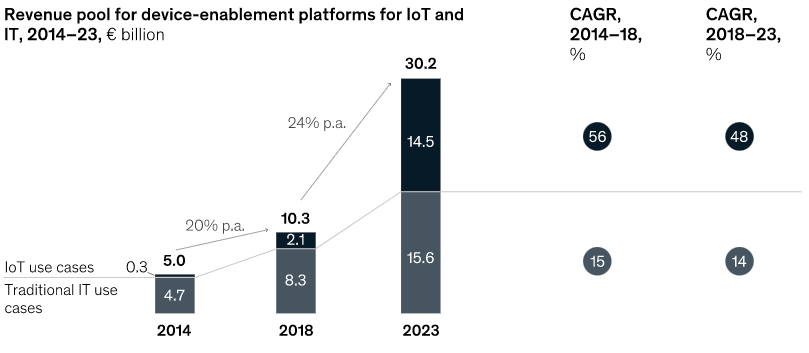
Figure 1: Revenue pool for device-enabled platforms, 2014-2023 (Dahlqvist et al., 2019)
While this can be used as an indicator of the potential payout of investing in and developing a 5G/IoT strategy, doing so will require a realignment of shared values. A successful strategy for a startup or a company will take a multi-tiered approach taking into account the needs of businesses in a 5G / IoT powered world and deliver value accordingly.
Build on Strengths
Companies that garner the most economic benefit from IoT are those who played to their strengths and add connectivity to their existing products. Those developing new products and services for their customers from the ground-up find themselves in the bottom quintile of economic return.
The first strategy should be to lower the barriers to implementation for IoT. This can be achieved in two ways.
Firstly, develop frameworks for easy deployment and integrations of solutions. This value enables new businesses to be free to not pump costs into R&D but focus on what they do best and what gives them their competitive advantage.
Secondly, to help achieve this, add consulting to your suite of services through learning from your experiences and being able to react to needs and offer tailored solutions. By building highly skilled developers and consultants in your team, SMEs as well as larger firms can turn to you with their strategies and your consultants can stand to learn more about the landscape and effectively draw in new clients to a growing ecosystem. Co-evolution and collaboration are vital in industries where network externalities are crucial to corporate success and the more customers see peers join a network, the stronger the network effect gets.
Growing the ecosystem and learning from new firms will lead to a competitive advantage for you in your relevant industries. Additionally, vertically integrating the stack from Developers to business decision-makers allows you to create value in ways rivals cannot.
Deploy Multiple use cases
One or two deployments of IoT services statistically does not make a transformative impact on firms. In fact, it’s been studied that the greater the number of IoT use cases, the greater the correlation with financial success. This number is approximately 30 IoT projects deployed after which the effect starts to level off. It is the momentum in propelling these initiatives that leads to the widespread adoption and efficiency of IoT projects.
You can stand to learn from this and pour as much brainpower as you can into R&D projects for 5G and IoT powered devices. One of the biggest trends in organizational behaviour in the digital age is an appetite for risk creating a bias towards action. Top talent wants to work on these innovative projects and building a culture enabling this has side benefits to just a happier workforce.
Efficiencies manifest themselves as engineers are able to develop and use similar frameworks and solutions across projects. Learning from a variety of projects can also deepen domain knowledge, increasing the value that you can offer to customers and increasing the potential number of new customers you can attract. For all you know, you might find a niche as your team gravitates towards solving a certain set of problems.
Embrace Business-Process Changes
IoT is not a be-all, end-all solution to the current business problems being faced by firms. However, if employed correctly, IoT devices can improve decision making by generating previously unobtainable data. However, while the data can be generated easily, without insights the data is of no use to frontline employees needing to leverage the data for better decision making.
As such, along with building products that improve connectivity, look to extend a suite of services to cloud-based analytics and consulting services that can package the newly generated data into useful insights relevant to managers and other decision-makers. Managing these changes will be crucial for success and if you lend both a hand and an extra set of eyes to your customers, you make yourself invaluable.
But always keep the user in mind! IoT will flourish and will change the way many businesses operate. But if we can democratize it at this early stage and break down barriers in understanding the relevancy, we can increase adoption and bring in outside perspectives to unlock a whole new realm of possibilities.
Pay Attention to Market Opportunities
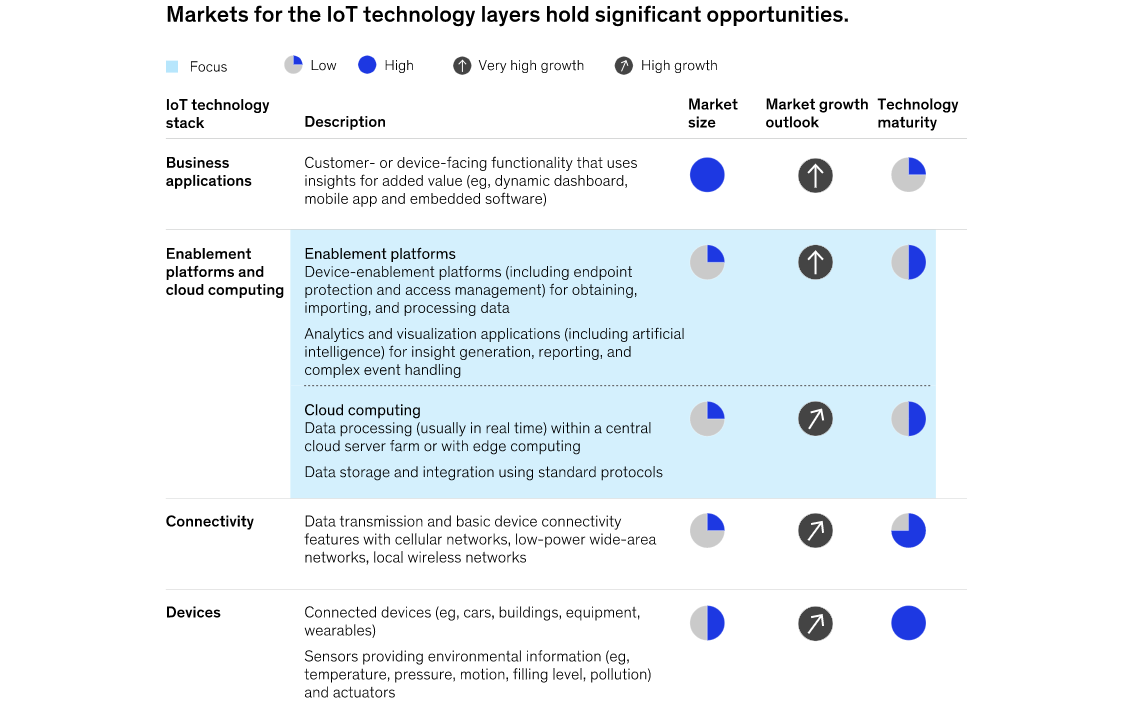
Building on the idea of learning while doing and identifying new possibilities, those looking to get into the device-enablement space have their pick of applications. Right now we’re in a stage where the most opportunities lie in improving business applications and the technology is relatively immature. This makes it an area that especially business users can maybe put their heads together to build.
Understanding data has never been more important. With platforms like thingful allowing you access to millions of sensors around the world, building ways to understand, package and relay that data to help others to do what they do best will make you so incredibly valuable.
But don’t forget about device-enablement. The market is small right now but projected to grow exponentially for the future. Those who get on board now, learn as much as they can and help other companies do better stand to cement themselves as future leaders.
work with Startups
Why pour money into something that’s already being done? Employ a mindset of “work with those who know and do it better”. If you’re a large firm and have the resources to invest heavily in developing new solutions internally, make use of the fact that business centers around the world are hotspots for tech startups and innovation. Look around to your community and focus energy in combining heads and working with startups involved in IoT but also related technologies such as cloud computing, big data analytics, cloud gaming, edge computing and cyber-security. Being able to quickly learn, collaborate and co-create will advance the work we can do in IoT and most importantly uplift you and those who you work with.
The right partnerships can stand to bring large returns and with IoT Collaboratives popping up around the world in research institutions, I’d love to see this be embraced more and more. Because as we’ve seen in the case of incubators and accelerators, those who work together learn and do better.
Understand Blockchain
Lastly, you need to understand Blockchain If you plan to do anything with the data from IoT sensors, it’s crucial that it be accurate, traceable and transparent. It would benefit you or your team to get a handle on the technology as you build out your solutions. While there are many resources available to get to grips with Blockchain in IoT, briefly Blockchain allows for authentication, security and transparency along the major points in the IoT device lifecycle:
Blockchain allows for authentication in registering a device enabling trust in the data generated from day 1
Through distributed ledgers, transactions and readings are transparent and can be traced along different axes
Transmission of data between devices can be authenticated and securely processed
Through the distributed ledger, Blockchain can allow fast transfer and coordination of many billions of sensors
As the ledger is virtually un-hackable, you can be certain of the accuracy and traceability of the data
Where to go from here?
No doubt 5G and IoT are set to disrupt the landscape of business interaction. However, the way in which you respond to this disruption will determine your possibility for future success. Find ways of providing value through education, consulting and increasing the ease of implementation. If you’re lucky enough to have the resources to offer high-end solutions, still be cognizant of the ability of young, lean, niche and agile startups who are offering value in innovative ways to consumers. Finally, pay attention to the tech that binds this all together. AI, blockchain, edge-computing - all these are just tools to help people connect or make sense of data better. So use them, and make your idea a reality.
These are just some of my ideas, but leave a comment, get in touch or drop me a line if you want to chat more! I always have time to discuss the exciting opportunities of the future.


Photo by Swapnil Bapat on Unsplash